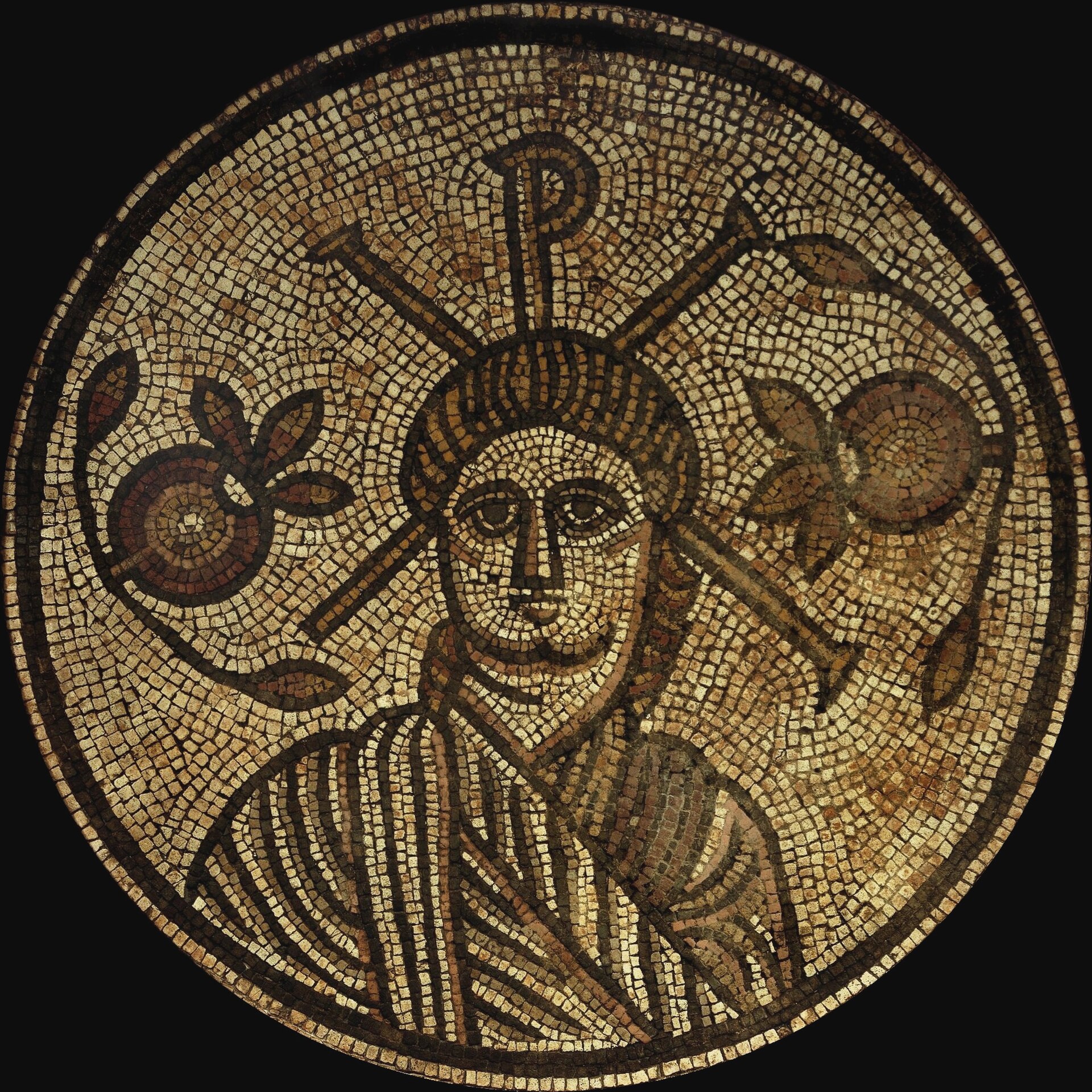
Hinton St Mary Mosaic (Christ Roundel)
Doctrinal reflection
The Hinton St Mary Mosaic, dated to the mid-4th century AD and now housed in the British Museum, London, was discovered in 1963 at a Romano-British villa site in Hinton St Mary, Dorset. Executed in tesserae of limestone, tile, and blue-black shale, the floor belongs to a domestic context, though scholarly debate persists as to whether the room served a private liturgical or simply prestigious residential function. The central roundel presents a frontal bust of a beardless male figure—identified by near-consensus as Christ—set against a white ground with the Chi-Rho (☧) monogram placed directly behind his head, functioning as a proto-halo. This juxtaposition of the Christogram with a figural portrait is without known parallel at so early a date and is thus considered a significant milestone in the formation of Christian iconographic conventions. Two pomegranates flank the Chi-Rho, symbols with layered resonance in late antique visual culture, evoking immortality, resurrection, and the abundance of eternal life. The figure's frontal, hieratic presentation anticipates the codified portrait conventions of later Byzantine icon production, though it remains firmly within a Roman mosaic tradition. Surrounding roundels depict the hunting of stags and hounds, integrating Christian imagery within a broader aristocratic visual program. The mosaic testifies to the penetration of Nicene Christianity into the northernmost reaches of the Roman Empire following Constantine's Edict of Milan (313 AD). Its theological program evokes the Incarnation (John 1:14), the cosmic lordship of Christ (Colossians 1:15), and eschatological sovereignty (Revelation 1:8). Sources: Journal of Roman Archaeology; Britannia (Society for the Promotion of Roman Studies); Oxford Journal of Archaeology.