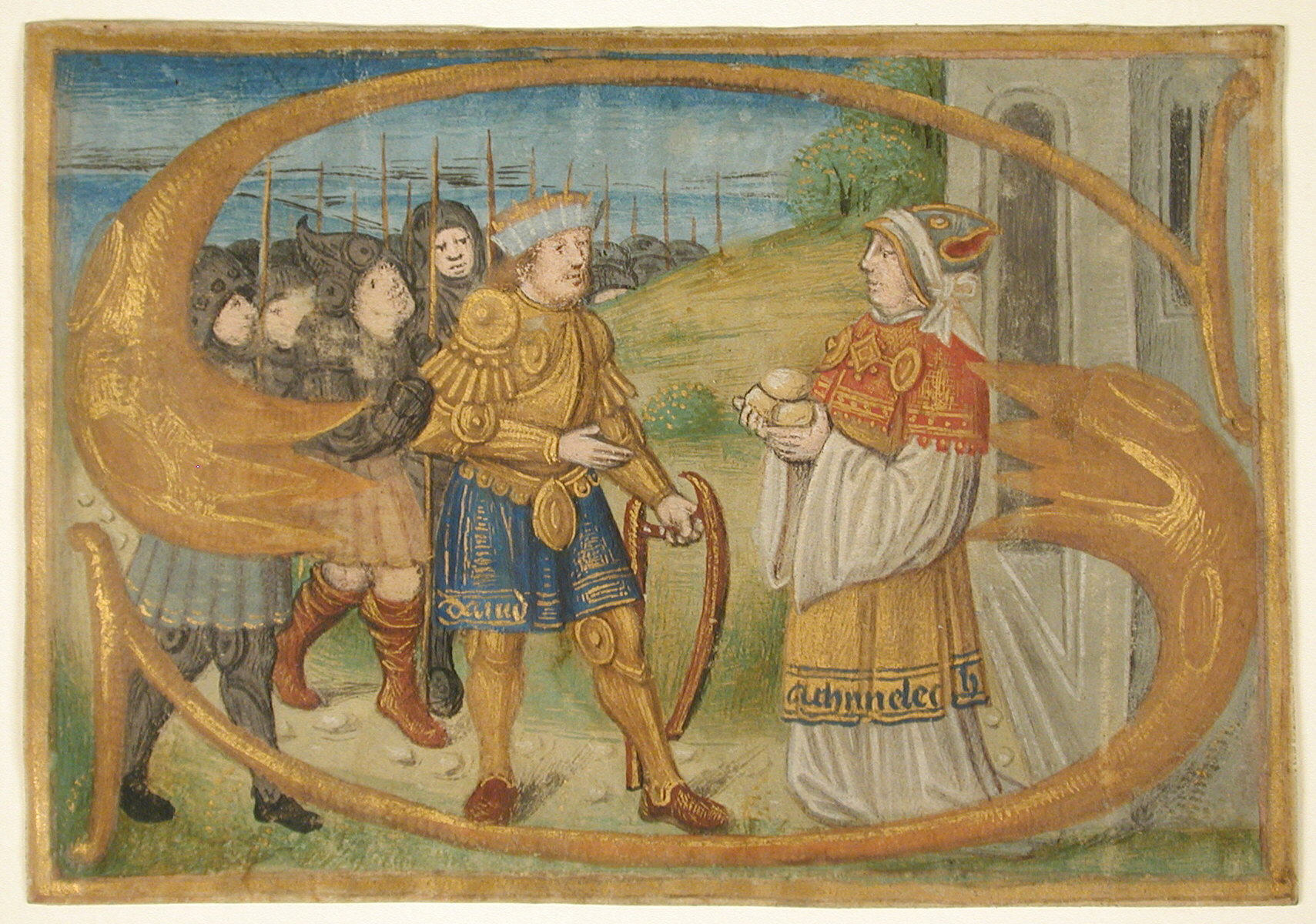
Manuscript Leaf Cutting Probably from a Missal with an Illuminated Initial S and King David Receiving the Holy Bread from Ahimelech the Priest.
Doctrinal reflection
This manuscript leaf cutting, dated to the late 15th century AD and held in the Medieval Art collection of the Metropolitan Museum of Art (Gift of Bashford Dean, 1923), is a French parchment fragment most probably excised from a missal. Executed in tempera, ink, and metal leaf, the leaf presents an illuminated initial 'S' enclosing a historiated miniature depicting King David receiving the holy bread (showbread) from Ahimelech the Priest at Nob, a scene drawn from 1 Samuel 21:1–6. This episode carries profound eucharistic typological resonance within the Latin liturgical tradition: the bread of the Presence (panis propositionis) prefigures the Eucharist, a typology Christ himself invokes in the Synoptic Gospels (Matthew 12:3–4; Mark 2:25–26; Luke 6:3–4). The choice of this scene within a missal context is therefore theologically deliberate, reinforcing the sacrificial and sacramental character of the Mass. Stylistically, the fragment belongs to Franco-Flemish illumination of the late Valois period, reflecting the polished technique—fine figure modelling, burnished metal leaf ground, jewel-toned palette—characteristic of Parisian or northern French ateliers circa 1470–1500 AD. The cutting practice, common from the 18th and 19th centuries, has detached this leaf from its original codex, obscuring precise liturgical placement; however, the 'S' initial suggests association with the Sanctus, Salve, or a saints' collect. The fragment is a modest but instructive specimen of late medieval liturgical book production and biblical typology in Western manuscript culture. Sources: Speculum: A Journal of Medieval Studies; Gesta; Journal of the Walters Art Museum.