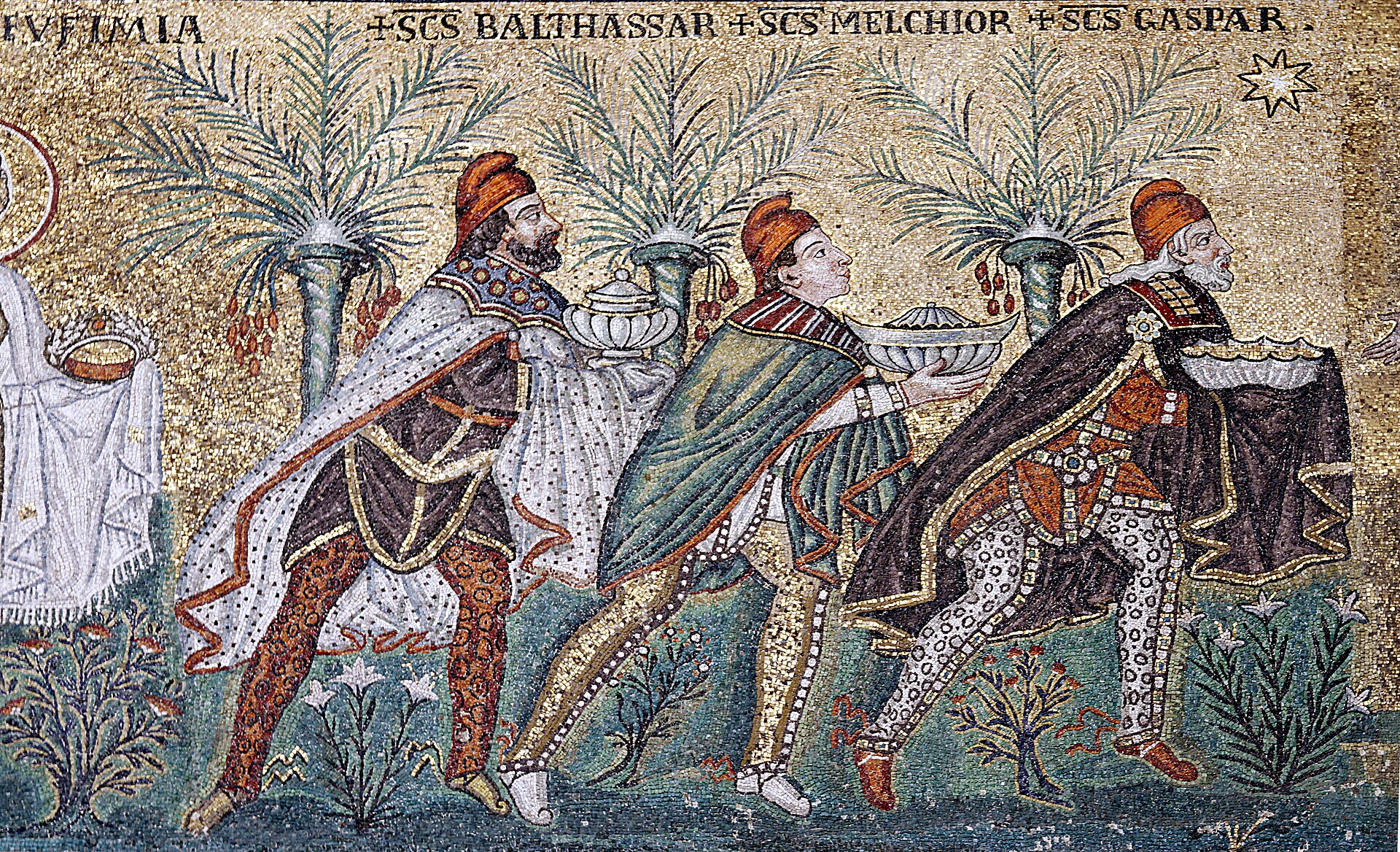
Procession of the Magi (Sant'Apollinare Nuovo)
Doctrinal reflection
The Procession of the Magi mosaic occupies the lower register of the north wall of Sant'Apollinare Nuovo, Ravenna, dateable to the reign of Theodoric and subsequent Justinianic reworkings of approximately 504–556 AD. Executed in tesserae of glass, gold, and stone, the composition presents three figures in Phrygian caps and ornate Persian trousers—a deliberate iconographic marker distinguishing them as Eastern foreigners—advancing in solemn processional stride toward the enthroned Virgin Theotokos with the Christ Child, flanked by angels. Each magus carries a gift held forward in veiled hands, a gesture of reverent presentation derived from late antique court ceremonial. Critically, titular inscriptions above the figures identify them as MELCHIOR, CASPAR, and BALTHASSAR, representing among the earliest surviving monumental attestations of these names in Christian art and constituting a significant fixed point for the history of Magi nomenclature. The naming convention, absent from the Gospel of Matthew itself, reflects the elaboration of parabiblical tradition by this period. The procession is formally continuous with the adjacent register of female martyrs advancing toward the same enthroned Christ, creating a unified liturgical and eschatological program expressive of the offering of the nations to the divine court. Iconographically, the Persian dress underscores Gentile inclusion within the economy of salvation, consistent with patristic exegesis of Isaiah 60. The panel's Arian origins under Theodoric and Justinianic repainting complicate its transmission history, a point addressed extensively in art-historical scholarship. Sources: Deichmann, Ravenna: Hauptstadt des spätantiken Abendlandes (1969–1989); Spieser, Urban and Religious Spaces in Late Antiquity and Early Byzantium (2001); Cormack, Byzantine Art (2000).