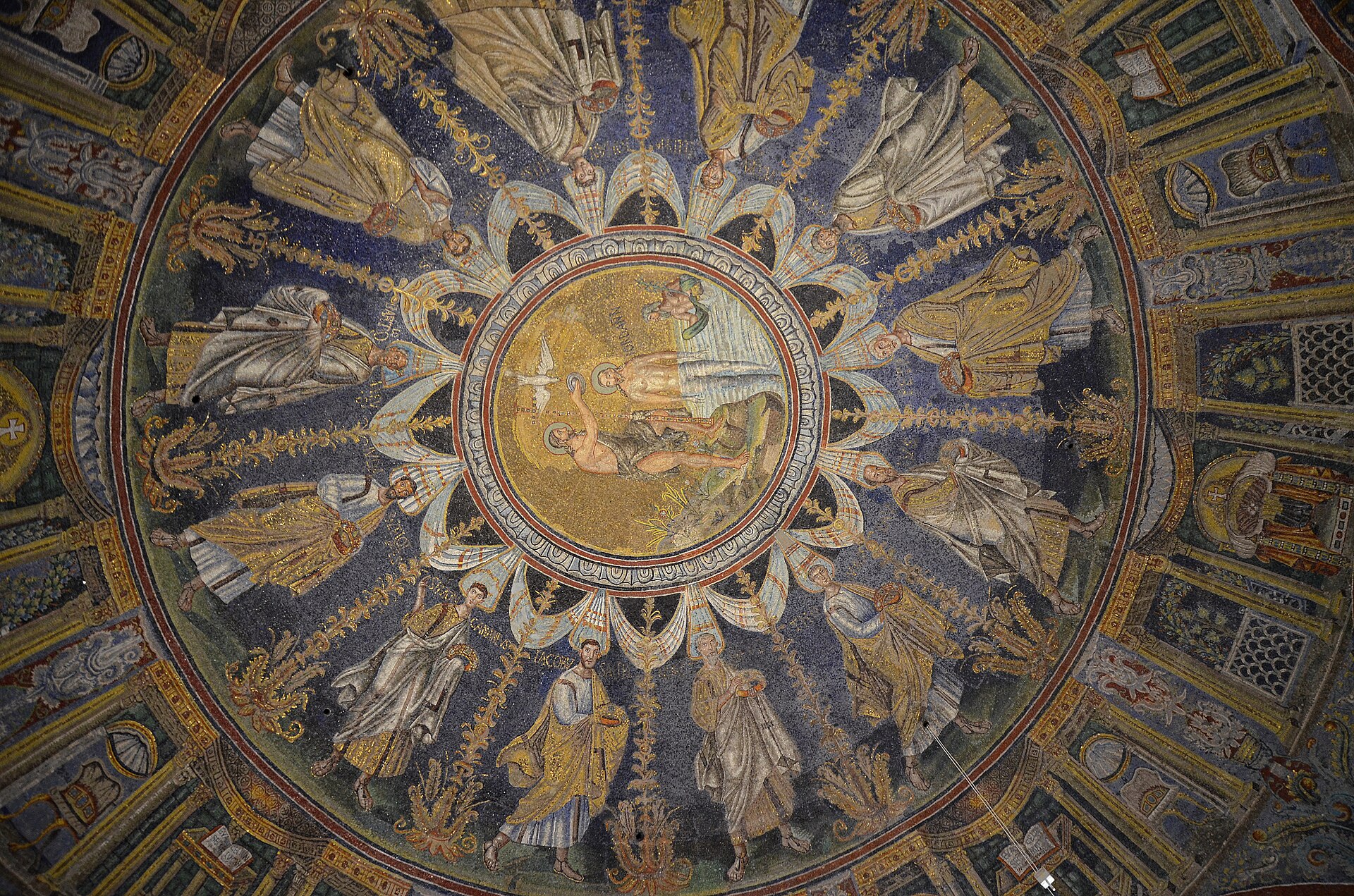
Baptism of Christ (Neonian Baptistery)
Doctrinal reflection
The Baptism of Christ mosaic occupies the apex of the dome in the Neonian (Orthodox) Baptistery, Ravenna, dated to approximately 450–460 AD under Bishop Neon, who oversaw the embellishment of an earlier Arian structure. Executed in glass and gold tesserae against a deep blue ground, the composition places Christ at center, nude and waist-deep in the Jordan River, receiving the Holy Spirit—rendered as a dove descending from above—while John the Baptist lays his right hand upon Christ's head. A striking iconographic feature is the inclusion of a bearded, reclining personification of the Jordan River god, borrowed from Greco-Roman allegorical convention, who cradles a reed and gestures toward the central event. This classical interpolation reflects the transitional character of Theodosian-era Christian art, which continued to draw on antique visual vocabulary to express emergent theological claims. The surrounding frieze of twelve apostles processing in two converging groups toward an enthroned hetoimasia reinforces a liturgical program directly linked to the baptismal rite performed beneath the dome—catechumens received the sacrament in direct visual alignment with the paradigmatic baptism of Christ. Theologically, the mosaic affirms Nicene Trinitarian orthodoxy: Father (implied through the divine hand or voice), Son, and Holy Spirit are visually co-present. The ensemble is frequently cited in scholarship on the Christianization of classical form and on the typological relationship between baptism and Trinitarian doctrine in late antique ecclesiastical decoration. Sources: Jahrbuch für Antike und Christentum; Dumbarton Oaks Papers; Robin Jensen, Baptismal Imagery in Early Christianity (Baker Academic, 2012).