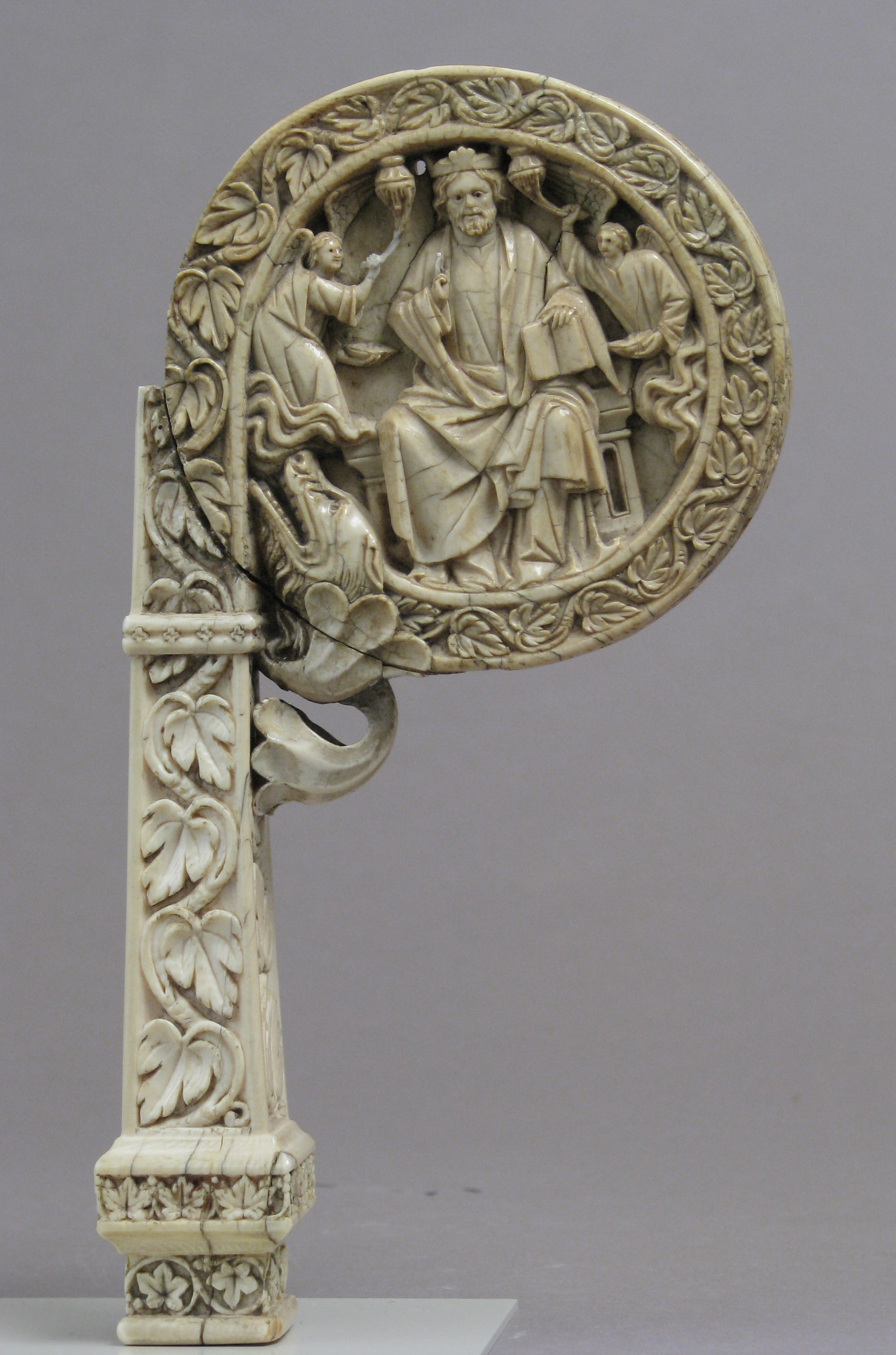
Ivory Crozier Head with Christ in Majesty and Throne of Wisdom
Doctrinal reflection
This ivory crozier head, dated to the thirteenth century and attributed to Italian or German workshops, presents a compound iconographic program uniting the Christ in Majesty (Maiestas Domini) with the Sedes Sapientiae (Throne of Wisdom) typology. Carved from elephant ivory, the object served as the terminal element of a bishop's pastoral staff, integrating liturgical function with doctrinal statement. The Christ in Majesty formula—derived from Ezekiel's theophanic vision and the Apocalypse of John—depicts the enthroned Christ within a mandorla, typically accompanied by the four evangelist symbols (tetramorphs), asserting his cosmic sovereignty over creation and history. The Throne of Wisdom component, in which the Virgin Mary functions as the living throne upon which the incarnate Logos is seated, conflates Christological and Marian theological registers, underscoring the Incarnation as the mechanism of divine condescension. The pairing on a crozier is theologically deliberate: the bishop, as shepherd of souls, carries the authority of the enthroned Christ whose vicar he is understood to be. Scholarly debate surrounds the precise regional attribution—Italian Romanesque and South German workshops both produced comparable ivory carving traditions in this period, and formal analysis of drapery treatment and figure proportions informs ongoing attribution discussions. The Metropolitan Museum's acquisition through the Frederick C. Hewitt Fund in 1911 places the object within early twentieth-century institutional collecting of medieval decorative arts. The work sits at the intersection of liturgical object studies, ivory carving technique, and episcopal iconography. Sources: Gesta (International Center of Medieval Art); Speculum (Medieval Academy of America); Arte Medievale.