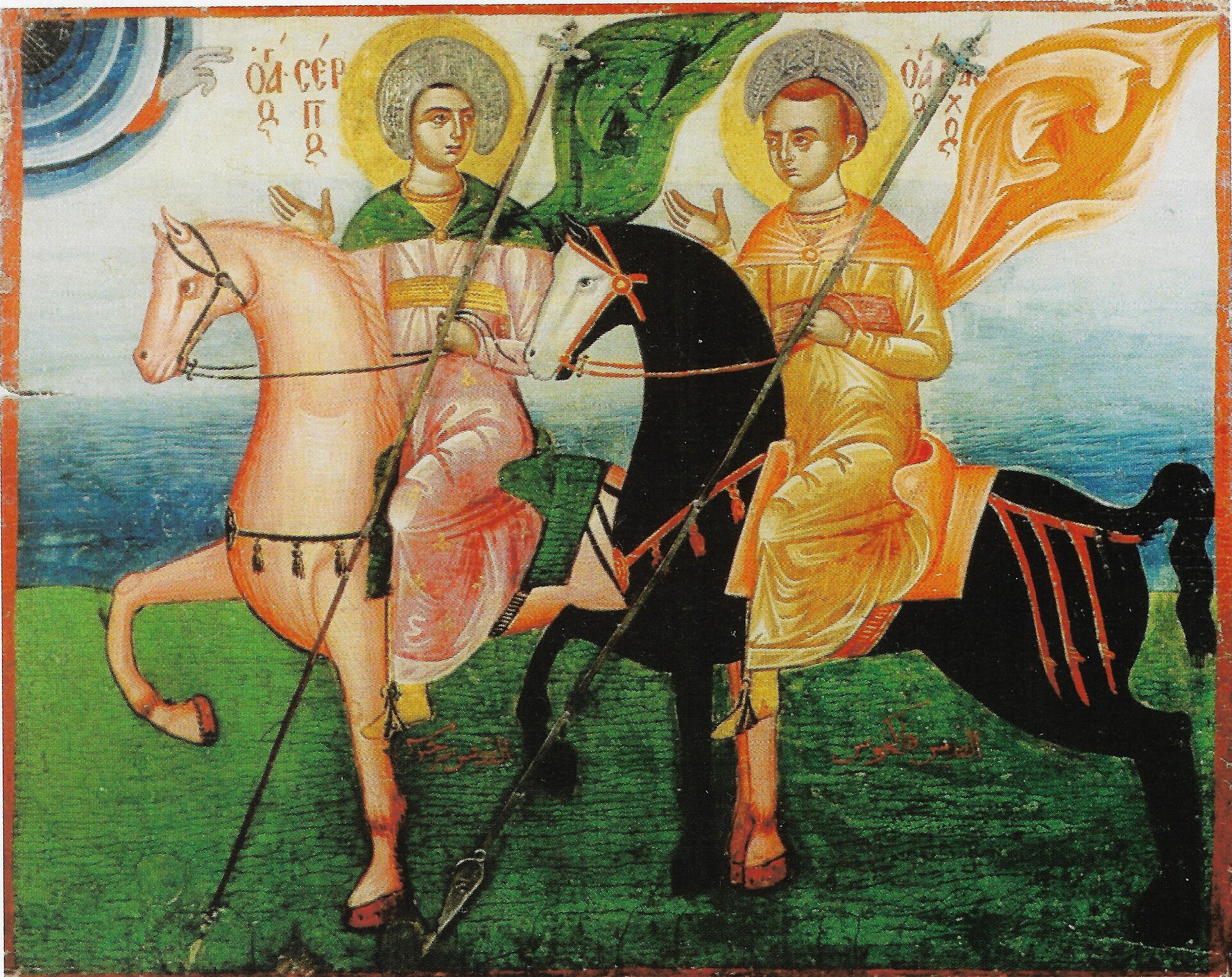
Sergius and Bacchus
Life and Ministry
Sergius and Bacchus were Roman military officers traditionally identified as members of the imperial army during the reign of Emperor Maximian (co-emperor, AD 286–305), though some accounts place their service under Galerius. Both were reportedly Christians who occupied positions of relative standing within the Roman military apparatus. According to hagiographic tradition, their faith was exposed when they refused to enter a pagan temple accompanying a superior officer, an act that constituted a formal breach of imperial religious obligation. Maximian, informed of their refusal, subjected the two men to public humiliation — reportedly stripping them of their military insignia and dressing them in women's garments before parading them — before ordering their transfer to the eastern provinces for further punishment. Sergius held the rank of primicerius and Bacchus that of secundarius, designations reflecting a command hierarchy within a scholae or similar unit, though the precise regiment remains disputed among scholars. Their martyrdom is placed at Resapha (later renamed Sergiopolis in Sergius's honor) in Roman Syria, dated conventionally to circa AD 303–305, consistent with the Diocletianic persecution. The cult of Sergius and Bacchus became one of the most widely distributed military-martyr cults in late antiquity, commanding devotion across Syria, Mesopotamia, and eventually Constantinople. The church of Saints Sergius and Bacchus constructed in Constantinople under Justinian I (circa AD 527–536) attests to the imperial prominence of their veneration. Modern scholarship has examined their Acts critically, noting formulaic hagiographic conventions while affirming a probable historical core. Sources: John Boswell, 'Same-Sex Unions in Premodern Europe' (1994); Woods, D., 'The Origin of the Cult of SS. Sergius and Bacchus,' in Analecta Bollandiana (1996); ODB (Oxford Dictionary of Byzantium).
Circumstances of Death
Following their public humiliation and transfer eastward, Bacchus is reported to have died from the severity of flogging en route, his body abandoned without burial according to the Acts. Sergius survived to reach Resapha in Roman Syria, where he was subjected to torture — forced to run in spiked boots — and subsequently beheaded, likely circa AD 303–305 during the Diocletianic persecution. The precise legal charge would have been refusal to perform sacrificial rites required of Roman soldiers, constituting apostasy from imperial religious duty.
Legacy
Sergius and Bacchus were venerated as saints in both Eastern and Western traditions from at least the late fourth century AD. Their feast day is observed on 7 October in the Roman Rite and in several Eastern calendars. Resapha was renamed Sergiopolis and became a major pilgrimage center. Emperor Justinian I rebuilt their Constantinople church, surviving today as the Küçük Ayasofya Mosque in Istanbul. They rank among the foremost military saints of the Eastern church alongside Theodore and George, and their cult spread as far as Gaul and Britain in late antiquity.
Sources
["Woods, D., 'The Origin of the Cult of SS. Sergius and Bacchus,' Analecta Bollandiana 116 (1998)", "Oxford Dictionary of Byzantium, ed. Kazhdan et al. (1991), s.v. 'Sergios and Bakchos'", "Delehaye, H., Les Legendes Grecques des Saints Militaires (1909)"]