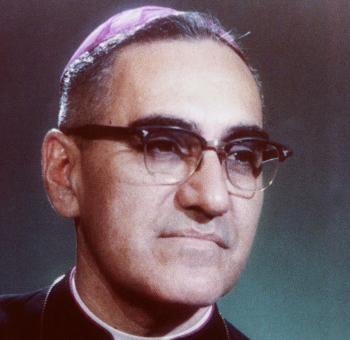
Oscar Romero
Archbishop Óscar Arnulfo Romero
Life and Ministry
Óscar Arnulfo Romero was born in 1917 in the mountain town of Ciudad Barrios in eastern El Salvador, the second of seven children in a working-class family. He entered seminary at thirteen, finished his theological studies in Rome in 1941, and returned to El Salvador as a parish priest. For three decades he was known as a quiet, theologically conservative cleric who steered well clear of the social activism then sweeping through the Latin American church under the influence of the Medellín Conference of 1968 and the rise of liberation theology. He was appointed Archbishop of San Salvador in February 1977 — chosen, the Salvadoran oligarchy and the apostolic nuncio supposed, as a safe administrator who would not threaten the country's military government. Three weeks after his installation, his close friend Father Rutilio Grande was assassinated on a country road by government death-squad gunmen.
Circumstances of Death
From the assassination of Grande forward, Romero became the public voice of the Salvadoran church against the Salvadoran state. Each Sunday, his cathedral homilies — broadcast nationally on the YSAX church radio station — read out the names of the dead and disappeared of the previous week. By early 1980 he was the most listened-to single voice in the country. On March 23, 1980, in his Sunday homily, he addressed the soldiers of the Salvadoran army directly: "I beg you, I implore you, I order you in the name of God: cease the repression." On the evening of March 24, while celebrating Mass at the chapel of the Hospital of Divine Providence in San Salvador, he was shot through the heart by a single rifle bullet at the moment of the offertory. The shooter was a Salvadoran soldier of the death-squad system run by former major Roberto D'Aubuisson; the order was signed by D'Aubuisson; the U.S.-allied Salvadoran government denied the killing for thirteen years.
Legacy
Romero's funeral, attended by an estimated quarter million Salvadorans in the cathedral square in San Salvador on March 30, 1980, was disrupted by army gunfire and bombings that killed dozens more. His death is the most widely accepted single trigger of the twelve-year Salvadoran civil war that followed. He was canonized by Pope Francis in 2018 — formally as a martyr in odium fidei, the Vatican having concluded that he was killed for his Christian witness rather than for political activity. His statue stands above the west door of Westminster Abbey among the twentieth-century martyrs. The phrase from his last interview, given two weeks before his death — "If they kill me, I will rise again in the Salvadoran people" — is carved on his tomb in the cathedral crypt.
Sources
James R. Brockman, Romero: A Life (Orbis, 1989); Óscar Romero, The Violence of Love (homily anthology, 1988); María López Vigil, Monseñor Romero: Memories in Mosaic (1993); UN Truth Commission Report on El Salvador (1993).