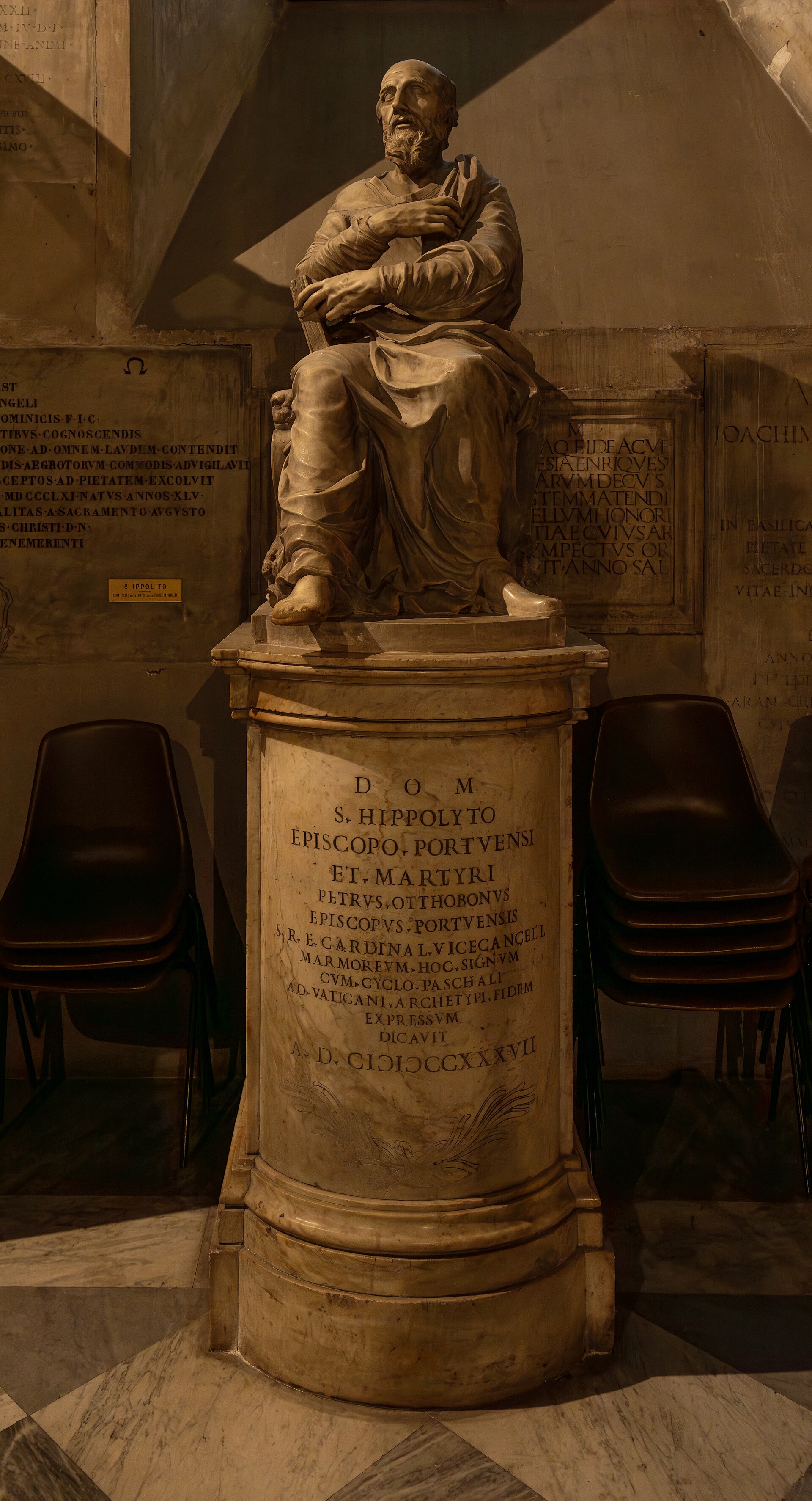
Hippolytus of Rome
Life and Ministry
Hippolytus of Rome (c. AD 170 – c. AD 235) stands among the most prolific theological writers of the early Latin and Greek church, though the precise details of his biography remain subjects of scholarly debate. He was likely a presbyter in Rome and a student, directly or indirectly, of Irenaeus of Lyon. His extensive literary output included the Refutation of All Heresies (Philosophumena), the Apostolic Tradition, and numerous biblical commentaries and chronographical works, making him a critical witness to early liturgical practice and doctrinal controversy. Hippolytus became embroiled in protracted disputes over penitential discipline and Christology, opposing what he characterized as the modalist tendencies tolerated by bishops Zephyrinus and Callistus I. This conflict led him to establish a rival episcopal succession, making him the first recorded antipope in church history. His schism persisted through the pontificates of Urban I and Pontianus. The accession of Emperor Maximinus Thrax in AD 235 precipitated a targeted persecution of Christian leadership in Rome, under which both Hippolytus and the legitimate bishop Pontianus were arrested and deported to the notoriously lethal mines of Sardinia. Ancient sources indicate the two were reconciled before or during their exile, and Hippolytus is understood to have died there. His remains, along with those of Pontianus, were reportedly returned to Rome under Pope Fabian around AD 236–237 and interred with honor. Sources: Acta Sanctorum (Bollandist corpus); J.B. Lightfoot, The Apostolic Fathers (1885); Alistair Stewart-Sykes, Hippolytus: On the Apostolic Tradition (St Vladimir's Seminary Press, 2001).
Circumstances of Death
Following his arrest during the persecution under Emperor Maximinus Thrax circa AD 235, Hippolytus was deported to the mineral mines of Sardinia, a sentence that functioned effectively as a death sentence given the extreme conditions of forced labor there. He died in those mines, likely from exhaustion, disease, or the brutal conditions endemic to such penal labor. He is believed to have been reconciled with the Roman church and its bishop Pontianus before or shortly after their mutual deportation. Pope Fabian subsequently retrieved his remains for honorable burial in Rome around AD 236–237.
Legacy
Hippolytus was venerated as a martyr from an early date, and his feast is observed on August 13 in the Roman Rite, where he is commemorated alongside Pope Pontianus. The Second Vatican Council's liturgical reforms retained his place in the General Roman Calendar. His theological and liturgical writings, particularly the Apostolic Tradition, exercised substantial influence on twentieth-century liturgical scholarship and reform. The Eucharistic Prayer II of the revised Roman Rite draws significantly on structures attributed to him, ensuring his ongoing relevance within Catholic sacramental theology.
Sources
["J.B. Lightfoot, The Apostolic Fathers, Part I: S. Clement of Rome (Macmillan, 1885)", "Alistair Stewart-Sykes, Hippolytus: On the Apostolic Tradition (St Vladimir's Seminary Press, 2001)", "Eusebius of Caesarea, Historia Ecclesiastica, Book VI (c. AD 313)"]