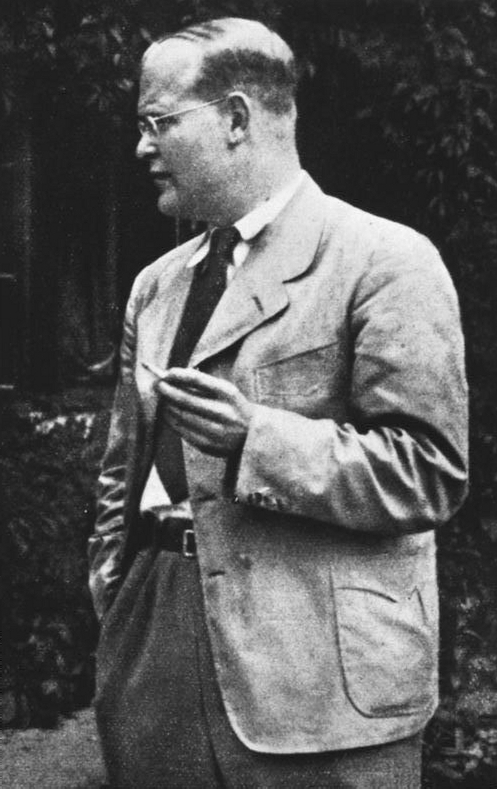
Dietrich Bonhoeffer
Pastor Dietrich Bonhoeffer
Life and Ministry
Dietrich Bonhoeffer was born in 1906 in Breslau to a wealthy academic family — his father Karl was Germany's leading professor of psychiatry. He took his doctorate at twenty-one with a dissertation, Sanctorum Communio, that the elder Karl Barth would call a theological miracle. He pastored briefly in Barcelona, studied at Union Seminary in New York under Reinhold Niebuhr, and from 1931 returned to Berlin as a lecturer in systematic theology. From the moment Hitler came to power in 1933 Bonhoeffer was an active opponent. He helped found the Confessing Church in 1934, ran an underground seminary at Finkenwalde from 1935 until the Gestapo closed it in 1937, and traveled abroad on behalf of the Confessing Church through the late 1930s while moving steadily from theological resistance into active conspiracy. The American Friends invited him to safety at Union in 1939; he sailed back to Germany after twenty-six days, having decided that he had no right to share in the rebuilding of German Christianity after the war if he did not share in its trial.
Circumstances of Death
Bonhoeffer worked from 1940 within the Abwehr, the German military intelligence service which under Admiral Wilhelm Canaris had become a center of the conservative resistance to Hitler. He served as a courier carrying information about the German resistance to Allied governments through neutral Sweden and Switzerland. He was arrested on April 5, 1943, in connection with a separate Abwehr matter, and held for two years in the Tegel military prison and then at Buchenwald. The discovery of the Abwehr archives in late 1944 — kept by Canaris despite Hitler's order to destroy them — confirmed his conspiracy involvement. He was transferred to Flossenbürg on April 8, 1945, court-martialed in summary proceedings the same night, and hanged at dawn on April 9, 1945, two weeks before American troops liberated the camp. The camp doctor recorded that Bonhoeffer prayed kneeling at the foot of the gallows and "died with the most edifying composure I have ever seen."
Legacy
Bonhoeffer's Letters and Papers from Prison (1951), edited from the smuggled correspondence of his last two years, became one of the most influential Christian theological texts of the twentieth century — the source of the phrases "religionless Christianity," "cheap grace," and "the cost of discipleship." His sister-in-law Renate Bethge and his closest friend Eberhard Bethge edited the complete works. The Confessing Church remained in name a small minority of German Protestantism, but the Bonhoeffer corpus shaped post-war German Protestant theology more deeply than any other voice. His name is one of the ten twentieth-century martyrs honored above the west door of Westminster Abbey.
Sources
Eberhard Bethge, Dietrich Bonhoeffer: A Biography (Munich, 1967; English 1970); Dietrich Bonhoeffer, Letters and Papers from Prison (1951); Bonhoeffer Werke (16 vols, complete works); Eric Metaxas, Bonhoeffer (2010, popular biography).