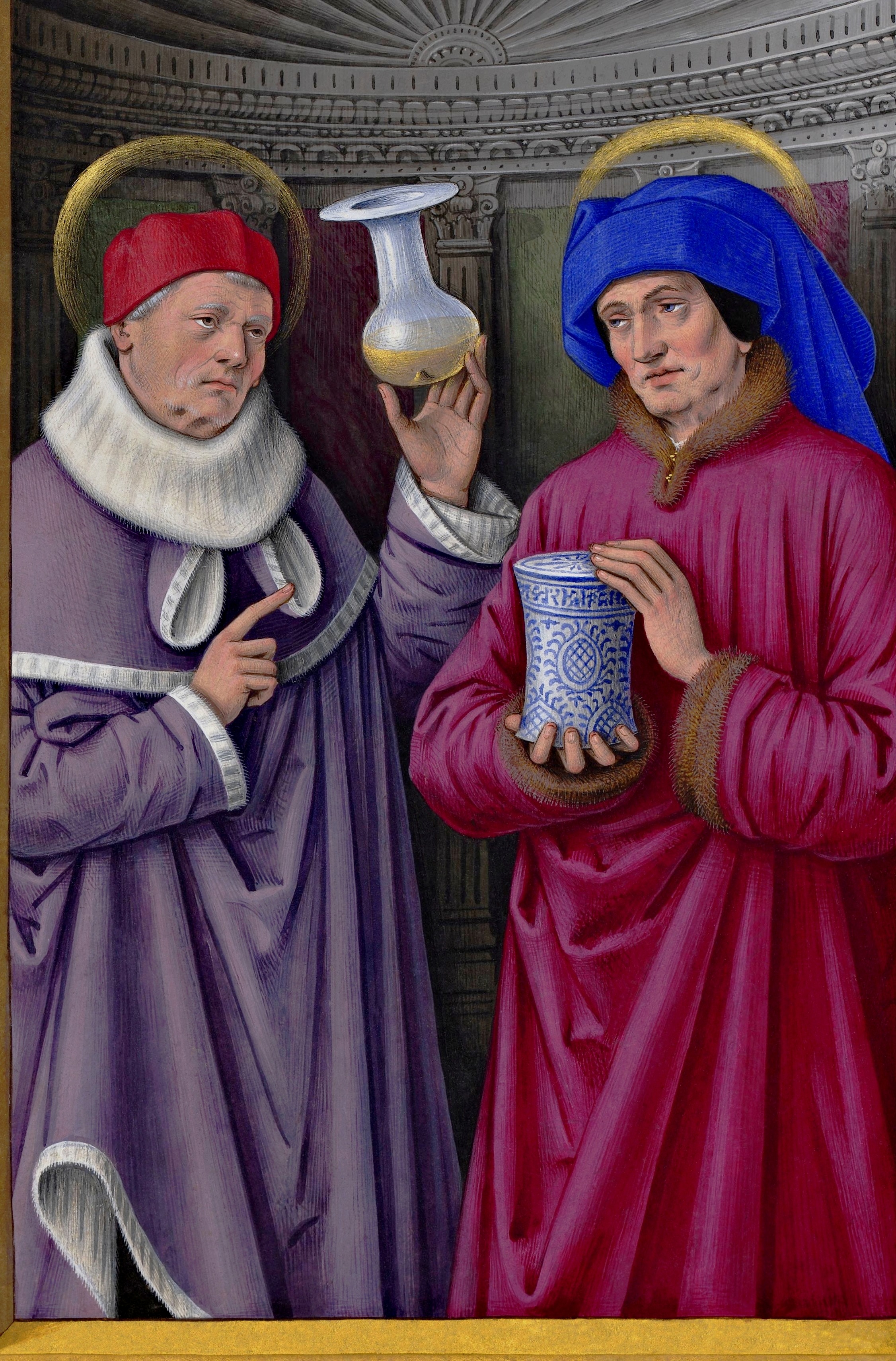
Cosmas and Damian
The Anargyroi (Silverless)
Life and Ministry
Cosmas and Damian were twin brothers, almost certainly of Arabian or Syrian origin, who practiced medicine in the region of Aegea in Cilicia, though Cyrrhus in Syria also claims significance as a center of their veneration. They are designated 'Anargyroi' — a Greek term meaning 'the silverless' or 'the unmercenary ones' — on account of their reported practice of treating patients without accepting payment, a characteristic that distinguished them in hagiographic tradition and contributed substantially to their popular appeal. Their historical existence is generally accepted by scholars, though the biographical details preserved in martyrologies are regarded as largely legendary in character. The brothers were reportedly arrested during a period of Roman imperial persecution of Christians, most commonly assigned to the reign of Diocletian, with proposed dates of death ranging from approximately AD 287 to AD 303 depending on the source tradition consulted. Following arrest, they are said to have endured multiple failed attempts at execution before ultimately being beheaded. Their cult emerged with particular vigor at Cyrrhus, where Theodoret of Cyrrhus documented a flourishing shrine in the fifth century AD, providing one of the earliest datable references to organized veneration. The cult subsequently expanded throughout the Byzantine world and into the Latin West, where a basilica dedicated to the pair was consecrated in Rome by Pope Felix IV around AD 530, incorporating structures from the Roman Forum. This Roman church became a major pilgrimage site and a vehicle for transmitting the iconographic and liturgical traditions associated with the saints across medieval Christendom. Sources: Theodoret of Cyrrhus, 'Historia Religiosa'; Hippolyte Delehaye, 'Les légendes hagiographiques' (Société des Bollandistes); John Osborne, studies on early Christian Rome in 'Papers of the British School at Rome'.
Circumstances of Death
Cosmas and Damian were arrested at Aegea in Cilicia under the authority of a Roman prefect named Lysias, according to the principal martyrological accounts, during the Diocletianic persecution of Christians, conventionally dated to c. AD 287 or AD 303. Having refused to renounce Christianity or offer sacrifice to the Roman gods, they were subjected to various tortures as recounted in hagiographic sources. Both brothers were ultimately executed by decapitation. The precise historical details remain uncertain, as the passio accounts are considered largely legendary by modern hagiographers.
Legacy
Cosmas and Damian were incorporated into the Roman Martyrology and are venerated on September 26 in the Western calendar and November 1 in the Byzantine rite. Their patronage of physicians, surgeons, and pharmacists established a durable institutional connection between the saints and medical practice throughout medieval and early modern Europe. The Rome basilica of Santi Cosma e Damiano remains an active church. In Eastern Orthodoxy they retain prominent status among the Anargyroi. Their iconographic tradition, particularly the motif of the miraculous leg transplant, exercised considerable influence on medieval medical and artistic culture.
Sources
["Theodoret of Cyrrhus, 'Historia Religiosa' (c. AD 444), ch. on the shrine at Cyrrhus", "Hippolyte Delehaye, 'Les l\u00e9gendes hagiographiques', Soci\u00e9t\u00e9 des Bollandistes, 4th ed. (Brussels, 1955)", "John Osborne, 'The Roman catacombs in the Middle Ages', Papers of the British School at Rome, Vol. 53 (1985)"]