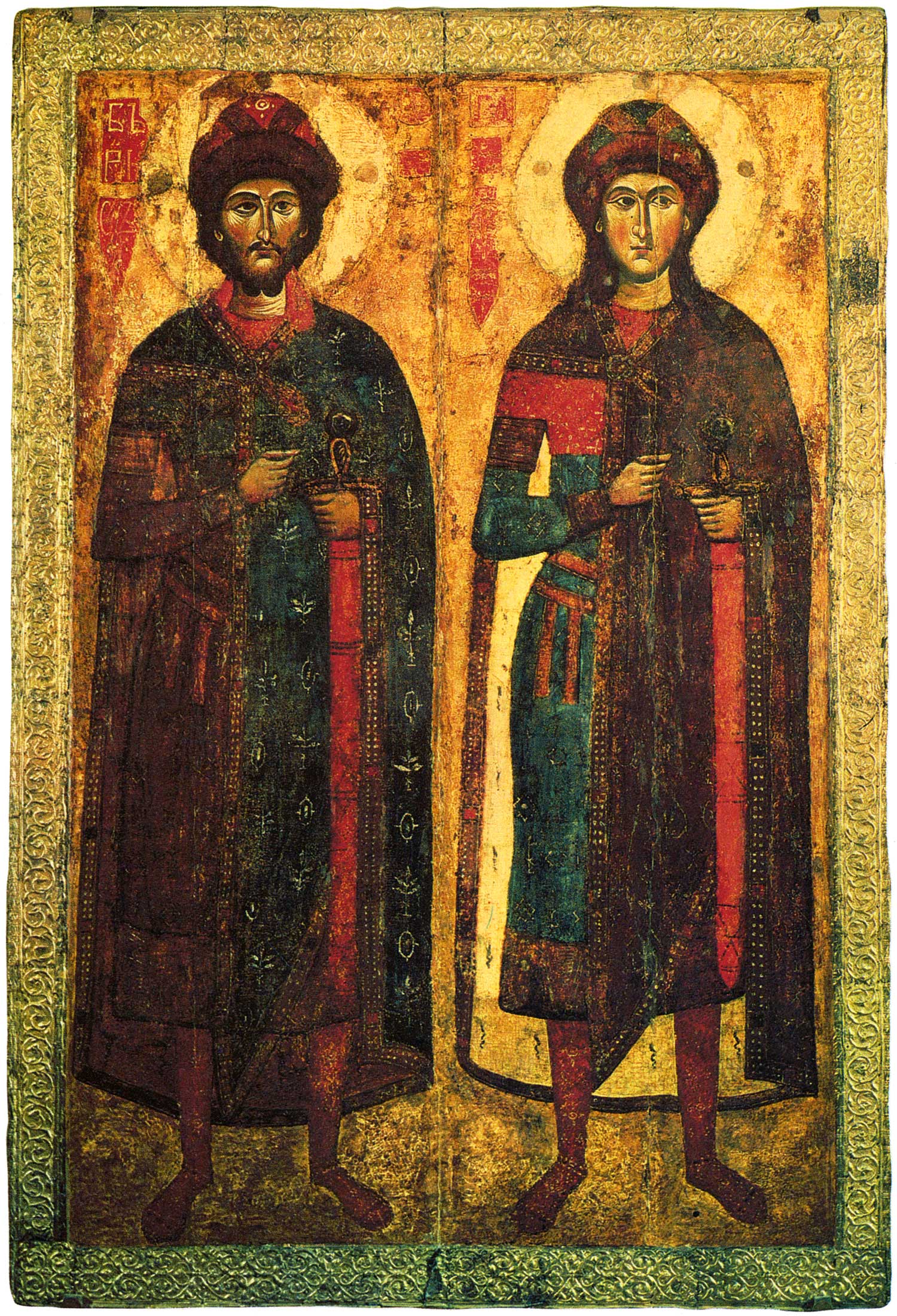
Boris and Gleb
The Holy Passion-Bearers
Life and Ministry
Boris and Gleb were sons of Vladimir I of Kiev, the Varangian-Rus' prince who oversaw the Christianization of Kievan Rus' in AD 988. Boris, likely the elder of the two brothers discussed here, governed the Rostov region, while Gleb held Murom. Both were reared in the newly Christianized court environment and received an education informed by Byzantine Christian ideals. When Vladimir died in AD 1015, a succession crisis immediately engulfed the Rurikid dynasty. Their half-brother Svyatopolk, later designated 'the Accursed' in chronicle tradition, moved to eliminate rival claimants to the Kievan throne. Boris, commanding a military retinue on campaign against the Pechenegs at the time of Vladimir's death, was approached by his troops with the option of marching on Kiev. He declined, reportedly citing unwillingness to raise arms against an elder brother. He was killed near the Alta River. Gleb was subsequently lured northward and murdered near Smolensk on the Smyadyn River. The Primary Chronicle (Povest' vremennykh let), the hagiographic account Chtenie by Nestor, and the Skazanie preserve the narrative of their deliberate non-resistance. Modern historians, including scholars such as Gail Lenhoff and Serge Zenkovsky, have examined these texts critically, noting both their literary construction and their probable historical core. The canonization of Boris and Gleb by the Rus' Church, formalized around AD 1072, established them as the first saints recognized by that ecclesiastical body independent of Constantinople's exclusive initiative. Sources: Gail Lenhoff, 'The Martyred Princes Boris and Gleb' (1989); Serge Zenkovsky, ed., 'Medieval Russia's Epics, Chronicles, and Tales' (1974); Donald Ostrowski, commentary in Harvard Ukrainian Studies volumes on Rus' hagiography.
Circumstances of Death
Boris was killed near the Alta River, likely in July AD 1015, by armed retainers sent by Svyatopolk; chronicle sources state he was aware of the approaching assassins and declined to flee or resist, accepting death in a posture of Christian submission. Gleb was killed shortly thereafter near the Smyadyn River confluence close to Smolensk, reportedly by his own cook acting on Svyatopolk's orders. Both deaths occurred in the immediate context of the dynastic struggle following Vladimir I's death.
Legacy
Boris and Gleb were formally canonized by the Rus' Church at a council held in Vyshhorod in AD 1072, with their relics translated in that ceremony. They are venerated as 'Passion-Bearers' (strastoterptsy), a category distinct from martyrdom in the strict confessional sense, emphasizing voluntary suffering in imitation of Christ's Passion. Their cult became foundational for a distinctive Eastern Slavic model of sanctity valorizing non-violent submission to unjust authority, and their iconographic and liturgical commemoration has persisted continuously in Russian and Ukrainian Orthodox tradition.
Sources
["Gail Lenhoff, 'The Martyred Princes Boris and Gleb: A Socio-Cultural Study of the Cult and the Texts' (Slavica, 1989)", "Serge Zenkovsky, ed., 'Medieval Russia's Epics, Chronicles, and Tales' (Dutton, 1974)", "Paul Hollingsworth, trans., 'The Hagiography of Kievan Rus'' (Harvard Ukrainian Research Institute, 1992)"]