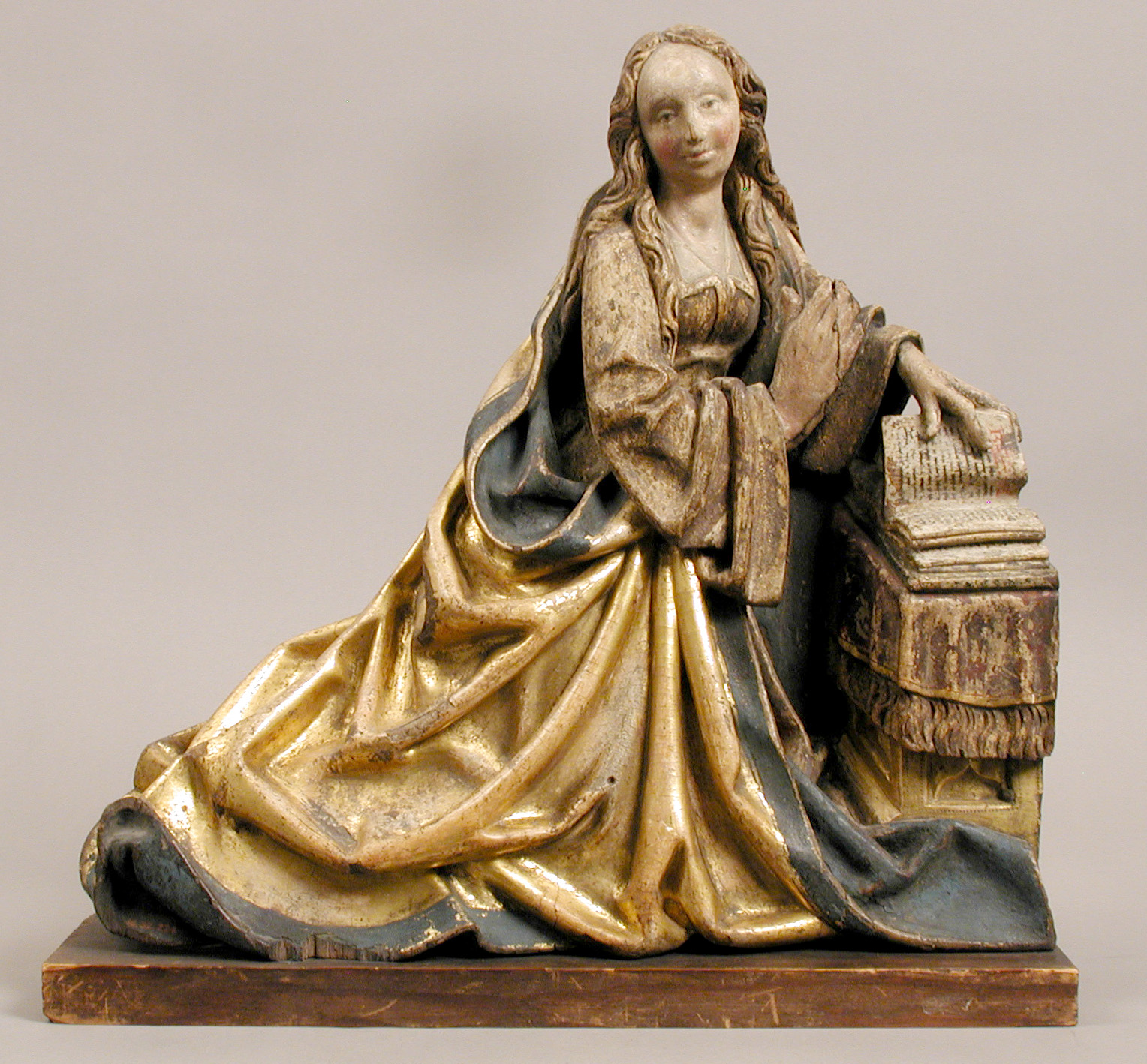
Virgin of the Annunciation
Doctrinal reflection
This entry presents a taxonomic challenge for a Byzantine-focused archive: the object in question is a South German oak relief statue with polychromy and gilding, dated to approximately 1450 AD, acquired by the Metropolitan Museum of Art through the gift of J. Pierpont Morgan in 1916. The work belongs unambiguously to the Western European late Gothic sculptural tradition, not to Byzantine or Eastern Christian artistic production. South German workshops of the mid-fifteenth century operated within the Latin Scholastic and Franciscan devotional frameworks, employing carved wood with applied polychromy and gilding characteristic of the Rhine-Danube regional school. The Annunciation iconographic type—depicting the Virgin Mary at the moment of the angel Gabriel's salutation as recorded in Luke 1:26-38—is shared across Byzantine and Western traditions, though formal treatment diverges substantially. Byzantine Annunciation imagery typically situates the Virgin spinning purple thread (referencing the Protevangelium of James) within a strict hierarchical compositional schema, while Western Gothic examples emphasize naturalistic drapery, physiognomic expressiveness, and three-dimensional spatial illusionism absent from Byzantine panel or mosaic conventions. Filing this object within a Byzantine Scriptorium archive is therefore an error of classification; the piece merits cataloguing under Gothic sculpture of the Holy Roman Empire. No meaningful Byzantine iconographic program, theological schema specific to Eastern Christianity, or technique associated with Byzantine production applies here. Scholars wishing to compare Annunciation typologies across traditions may consult the relevant comparative literature. Sources: Metropolitan Museum of Art Bulletin; Zeitschrift für Kunstgeschichte; Gesta: International Center of Medieval Art.