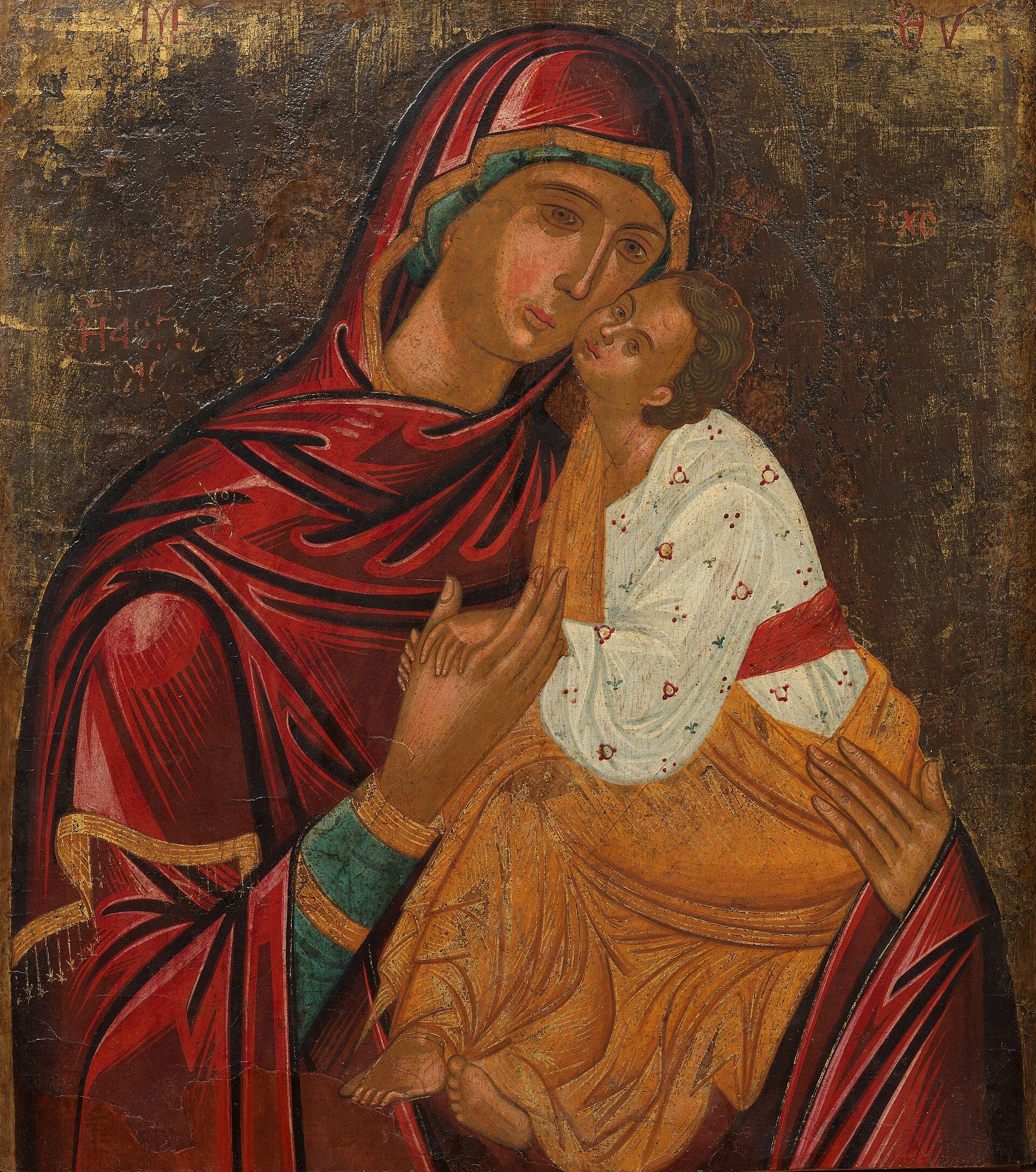
The Virgin Glykophilousa (Sweet-Kissing)
Doctrinal reflection
This sixteenth-century AD panel painting, attributed to the Cretan school and held in the National Museum of Art, Architecture and Design, Oslo, represents the Virgin Glykophilousa ('sweet-kissing'), a subtype of the broader Eleousa or Tenderness category in which the Mother of God and the Christ Child press their cheeks together in intimate contact. The work belongs to the mature phase of Cretan icon production, which, operating under Venetian administration following the Ottoman conquest of Constantinople in 1453 AD, synthesized the inherited middle-Byzantine stylistic canon with selective Latin pictorial conventions—notably the modelling of drapery and the treatment of spatial depth—without abandoning the theological grammar of the Byzantine prototype. Iconographically, the Virgin is rendered in the standard maphorion of dark blue over red, her head inclined toward the Child, whose right hand typically reaches toward her face or neck in a gesture simultaneously filial and redemptive. The juxtaposition of maternal tenderness with the Christ Child's solemn or pensive demeanor encodes the Passion typology within a scene of infancy, a theological tension fundamental to the Eleousa program. The Glykophilousa emphasizes the hypostatic union through bodily proximity: the divine Logos assuming full human affectivity. The Cretan school's significance lies in its role as primary transmitter of Byzantine iconographic continuity into the early modern period, training figures including Domenikos Theotokopoulos (El Greco) and supplying icons to Orthodox communities across the Mediterranean. Scholarly attention focuses on workshop practices, the negotiation of Latin and Byzantine norms, and the panel's material stratigraphy. Sources: Deltion of the Christian Archaeological Society; Jahrbuch der Österreichischen Byzantinistik; Byzantine and Modern Greek Studies.