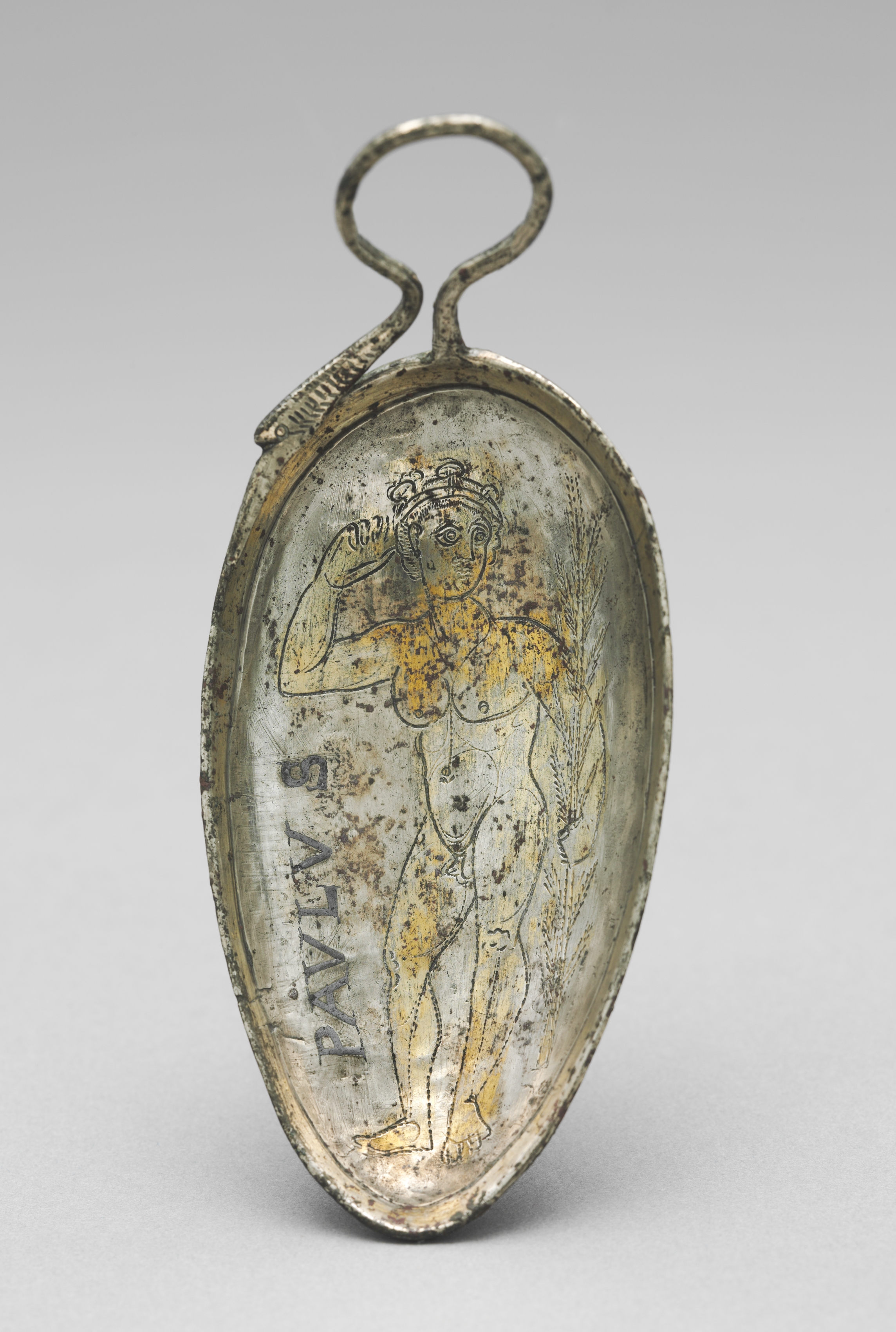
Spoon with Saint Paul as an Athlete
Doctrinal reflection
This silver, silver gilt, and niello ligula spoon, dated to approximately AD 350–400 and attributed to the late Roman Empire, possibly Syria, represents a fascinating liminal object at the intersection of classical material culture and emergent Christian iconographic sensibility. The spoon belongs to the swan-neck handle (ligula) type widely distributed across the Late Roman Empire as luxury tableware for elite dining and display. What distinguishes this example is the nude victorious athlete rendered in the figural tradition of Greco-Roman athletic iconography, accompanied by the niello-inlaid inscription PAVLVS. The juxtaposition of the classical athletic nude with a specifically Pauline identification invites careful iconographic reading. Scholars have noted the probable allusion to 1 Corinthians 9:24–27, wherein Paul deploys the extended metaphor of the athletic contest—stadium running, boxing, self-discipline—to characterize the Christian apostolic vocation. The object thus operates on at least two registers simultaneously: as a conventional prestige item for secular dining, and as a potentially coded Christian reference legible to a literate owner familiar with Pauline epistolary literature. This interpretive layering is characteristic of fourth-century Christian material culture, in which explicit religious imagery was not yet normative and classical forms were frequently adapted to new theological purposes. The medium—metalwork rather than mosaic, fresco, or panel icon—situates the piece within the broader category of early Christian minor arts, which remain an underexplored zone of iconographic production. Conservative scholarly opinion resists over-reading the object as liturgical, emphasizing its probable secular function. Sources: Journal of Early Christian Studies; Dumbarton Oaks Papers; Late Antique Archaeology.