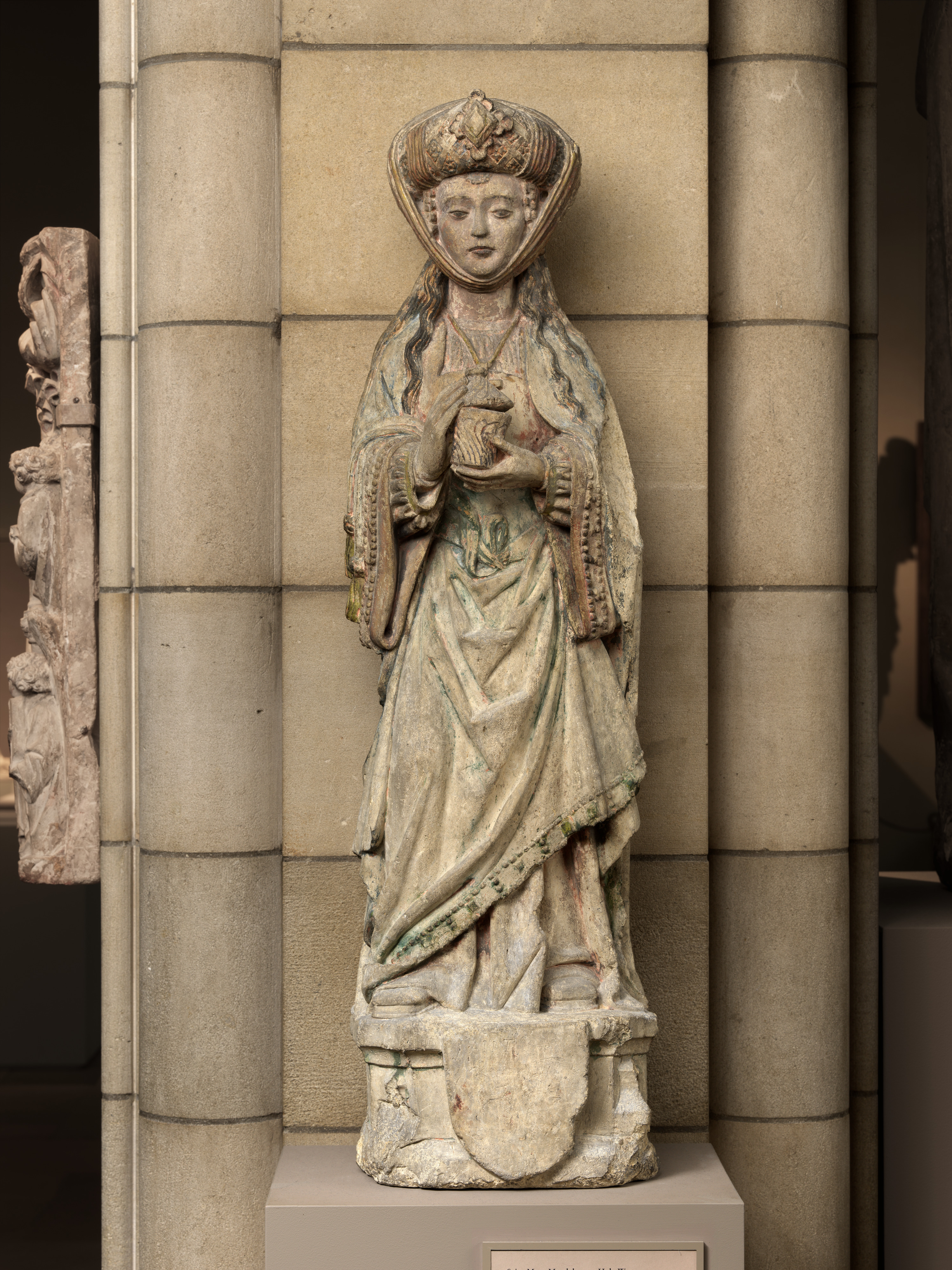
Saint Mary Magdalene
Doctrinal reflection
This entry presents an archival challenge: the object in question is a French limestone sculpture with traces of polychromy, dated circa 1500–1525, gifted to the Metropolitan Museum of Art by J. Pierpont Morgan in 1916. It falls outside the strict parameters of Byzantine visual culture—being a Western European, late Gothic or early Renaissance sculptural work rather than an icon, mosaic, fresco, or Byzantine manuscript illumination. As a Scriptorium archive dedicated to Byzantine art, a compliant entry cannot be responsibly generated for this object without misrepresenting its cultural and material context. The sculpture belongs to the Latin West's devotional tradition, specifically the Franco-Flemish or Burgundian sculptural milieu of the late fifteenth to early sixteenth century, where Mary Magdalene was frequently depicted as a penitent saint carrying her attribute of the unguent jar (alabastron). Iconographically, she draws on Luke 7:37–38 and John 20:11–18, but her treatment here is entirely Gothic-Western in formal language, not Komnenian or Palaiologan. Forcing this object into a Byzantine schema would constitute a categorical error of art-historical method. Scholars interested in comparative Magdalene iconography across East and West may consult the relevant literature on both traditions separately. Sources: Metropolitan Museum of Art Bulletin; Gesta: International Center of Medieval Art; Burlington Magazine.