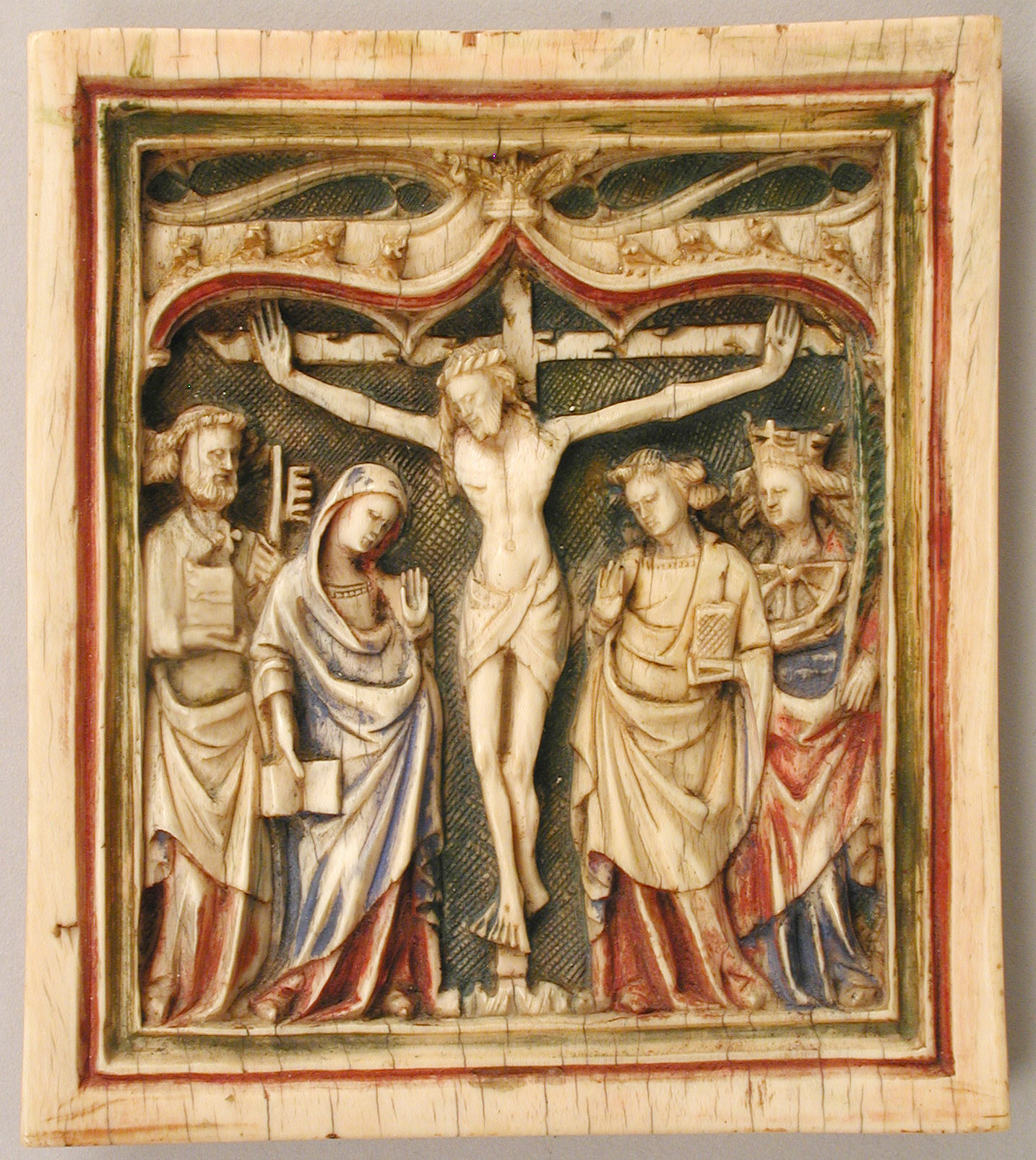
Plaque with the Crucifixion
Doctrinal reflection
This South Netherlandish ivory plaque depicting the Crucifixion dates to approximately AD 1400–1425 and is now held in the Medieval Art collection of the Metropolitan Museum of Art, New York (Gift of J. Pierpont Morgan, 1917). Carved from elephant ivory with surviving traces of polychrome paint, it belongs to a well-documented tradition of Netherlandish devotional ivories produced in the late Gothic period, when the Low Countries had supplanted Paris as a leading center of luxury ivory carving. The plaque's relatively modest dimensions are characteristic of objects intended for private devotional use or incorporation into polyptych altarpieces. Iconographically, the composition follows established Crucifixion conventions: Christ on the cross with the titulus INRI above (per John 19:19), typically flanked by the Virgin Mary and the Apostle John (John 19:26–27), with Mary Magdalene at the foot of the cross per medieval tradition synthesizing the gospel accounts of the women present (Matthew 27:55–56; Mark 15:40; John 19:25). Secondary figures may include soldiers and lamenting angels, stock elements of Passion iconography by this period. The theological program centers on Christ's atoning death, visually underscored by the wound in his side (John 19:34), and the gathering of witnesses Scripture names. The polychrome treatment—now fragmentary—was standard for Netherlandish ivories of this era, lending the figures pictorial warmth beyond the sculptural form alone. Scholarly significance lies in the plaque's evidence for cross-media influence between panel painting and ivory carving in the early fifteenth-century Low Countries. Sources: Koechlin, Raymond, Les ivoires gothiques français (1924); Randall, Richard H., Jr., Masterpieces of Ivory from the Walters Art Gallery (1985); Gaborit-Chopin, Danielle, Ivoires médiévaux (2003).