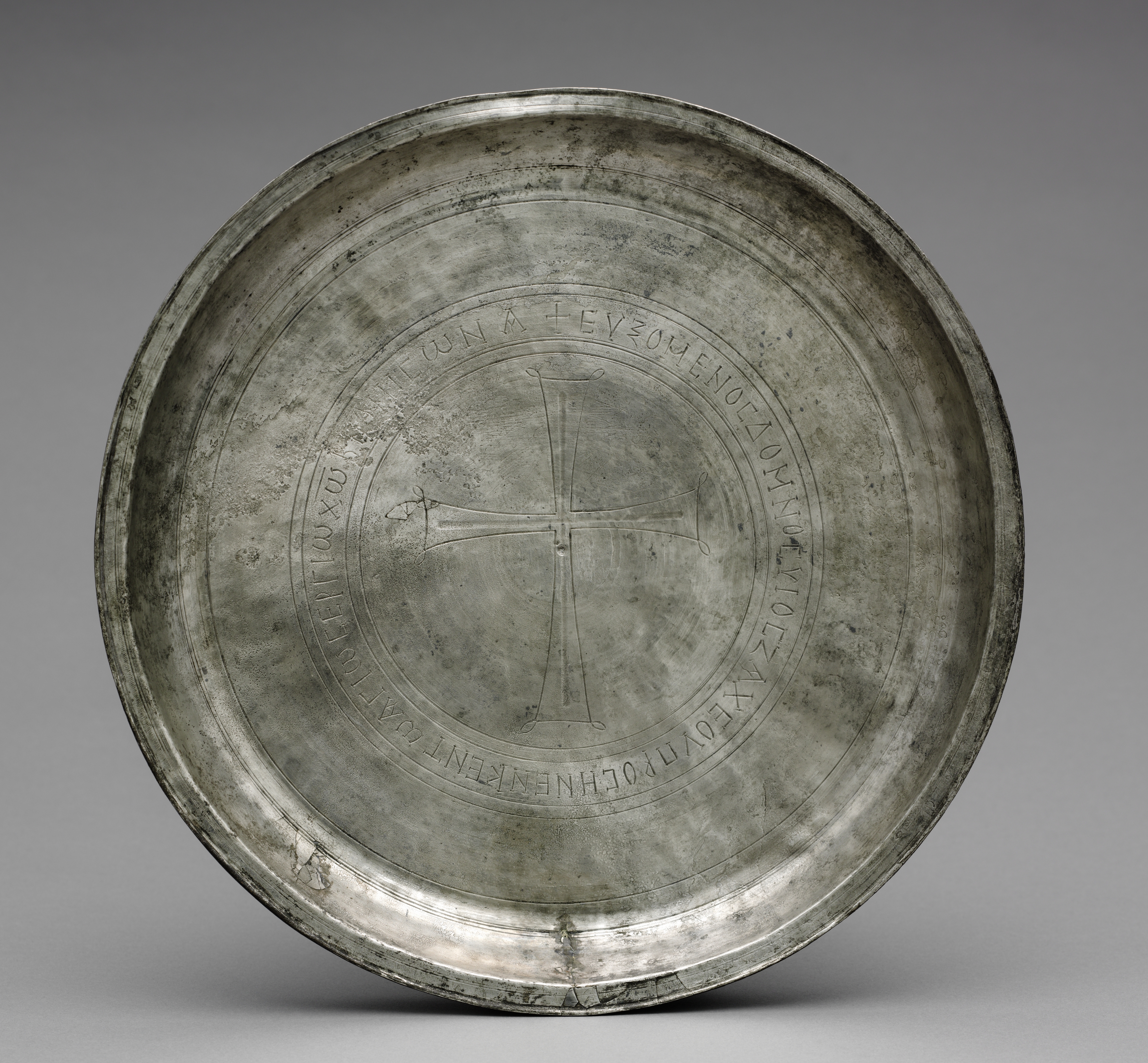
Paten (Dedicated to Saint Sergius) from the Beth Misona Treasure
Doctrinal reflection
The Beth Misona Treasure paten (Cleveland Museum of Art, acc. no. 1950.378) is a silver liturgical vessel dateable to approximately AD 500, originating from a Syrian Christian community, with scholarly debate situating its manufacture either in Constantinople or a regional Syrian workshop. The paten belongs to a group of four pieces—one paten and three chalices—named for the village of Beth Misona in northern Syria, where they functioned as church silver before almost certainly being buried to conceal them from Persian or Arab conquest in the first half of the seventh century AD. The object's primary decorative program is restrained: an engraved Latin cross occupies the central field, surrounded by a dedicatory inscription in Greek identifying the donor as Domnos and specifying the intended locus of liturgical use as the church of Saint Sergios at Beth Misona. This epigraphic formula follows conventions well attested in Syrian votive silver of the late fifth and sixth centuries AD. The paten's theological program is eucharistic: as the vessel upon which the consecrated bread was distributed during the anaphora, its cross imagery directly engages the sacrificial theology of the liturgy, visually marking the bread as the body of Christ. The dedication to Saint Sergios, a soldier-martyr venerated intensely across Syria and Mesopotamia, reflects the regional cult landscape of late antique Christianity. Scholarly interest in this piece centers on questions of provincial versus metropolitan workshop attribution and on the broader phenomenon of Syrian church treasures buried during the seventh-century conquest period. Sources: Dumbarton Oaks Papers; Journal of the Walters Art Museum; Antiquity.