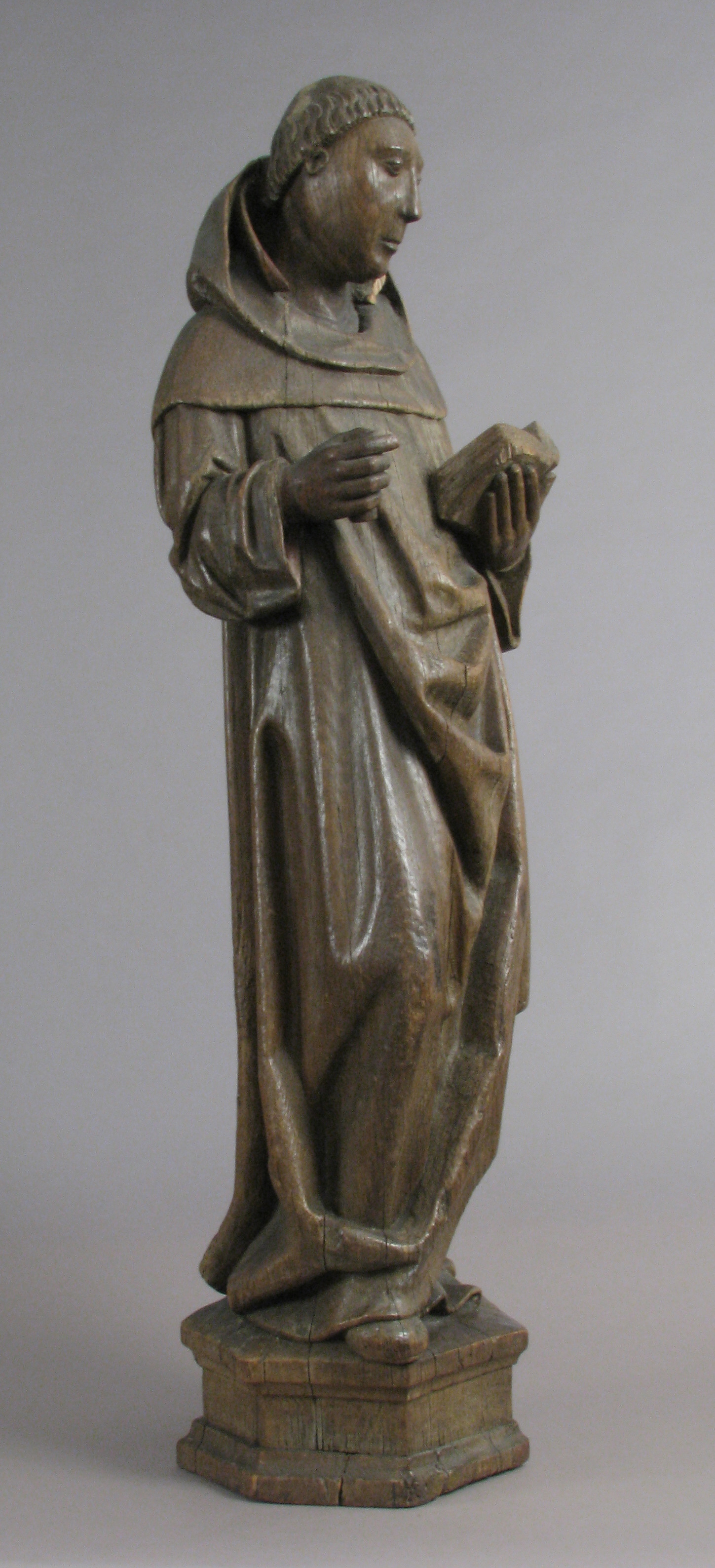
Monastic Saint
Doctrinal reflection
This oak sculpture, catalogued as 'Monastic Saint' and attributed tentatively to a Netherlandish workshop circa AD 1480, represents the late-medieval devotional tradition of carved wooden saints produced for private chapels, altarpieces, or institutional settings in the Low Countries. The entry falls outside Byzantine media strictly defined, yet the Scriptorium archive documents it as a cognate artifact of medieval Christian visual culture. The figure's monastic habit—the primary iconographic indicator—signals affiliation with one of the major Western orders (Benedictine, Cistercian, Franciscan, or Dominican), though no attribute specific enough for secure identification survives or is recorded. The Metropolitan Museum's description prudently withholds a named identification, and scholarly caution is warranted: late-medieval Netherlandish workshops produced generalized monastic figures in considerable numbers for devotional and commemorative use, and without a distinctive attribute (book, lily, stigmata, skull, or instrument of passion), a single-saint identification would be speculative. Stylistically, the work belongs to the South Netherlandish or Brabantine tradition of polychrome or naturalistic oak carving, which reached technical maturity in the third quarter of the fifteenth century AD and influenced German and English production. The gift of J. Pierpont Morgan in AD 1916 places the piece within the celebrated Morgan medieval collection, a primary source for the Met's medieval holdings. The theological program is that of the imitatio Christi as mediated through monastic profession—a tradition documented historically but not equated here with biblical prescription. Sources: Metropolitan Museum of Art Bulletin; Williamson, Gothic Sculpture 1140–1300 (Yale, 1995); Steyaert, Late Gothic Sculpture: The Burgundian Netherlands (Ghent, 1994).