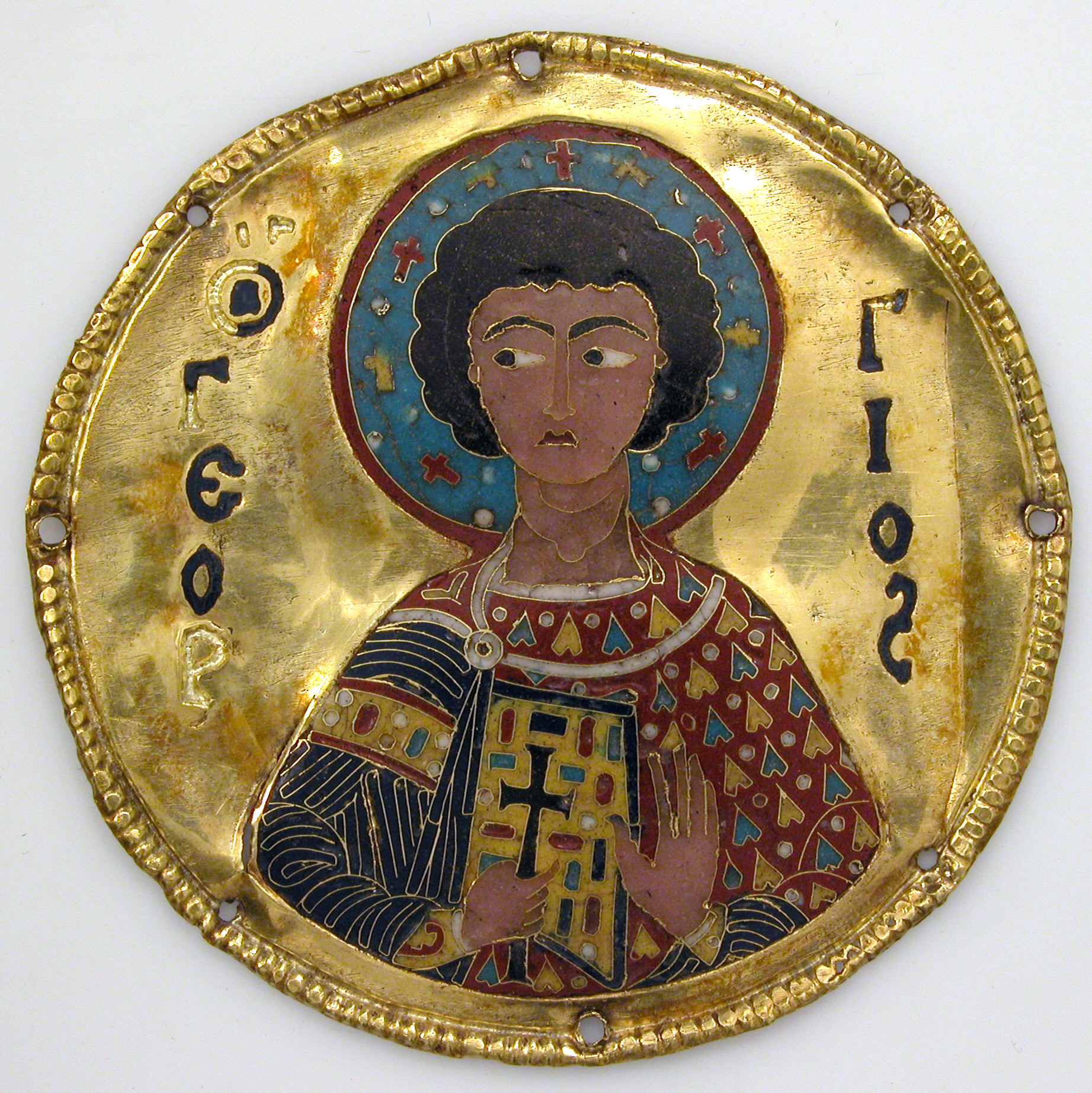
Medallion with Saint George from an Icon Frame
Doctrinal reflection
This cloisonné enamel medallion depicting Saint George, dated to approximately 1100 AD, represents a discrete element extracted from a larger icon frame, a common Byzantine practice of adorning venerated panel icons with precious metalwork borders housing busts of saints in medallion format. Executed in gold and silver with polychrome cloisonné enamel, the object exemplifies the high technical achievement of middle Byzantine goldsmith workshops, most likely located in Constantinople, where court-affiliated ateliers produced luxury liturgical metalwork of this caliber. The use of cloisonné—thin metal partitions soldered to a gold ground, filled with vitreous enamel paste, and fired—allowed for precise chromatic articulation of facial features, military attire, and inscriptional tituli characteristic of saint identification in Byzantine art. Saint George is conventionally represented as a youthful military martyr, and medallion busts from icon frames of this period typically render him frontally in three-quarter bust, wearing a chlamys and occasionally armor, conforming to the hieratic typology codified after the Triumph of Orthodoxy in 843 AD. The medallion's function as part of an icon frame underscores the Byzantine theological understanding of the icon as a sacred threshold: the surrounding saints in medallions participate in the devotional efficacy of the central image, extending its intercessory network. The gift of J. Pierpont Morgan to the Metropolitan Museum in 1917 situates this object within the early twentieth-century formation of major American Byzantine collections. Comparable ensembles survive in the treasury of San Marco, Venice, and in the Dumbarton Oaks collection. Sources: Byzantium: Faith and Power (Metropolitan Museum of Art, 2004); Dumbarton Oaks Papers; Byzantine and Modern Greek Studies.