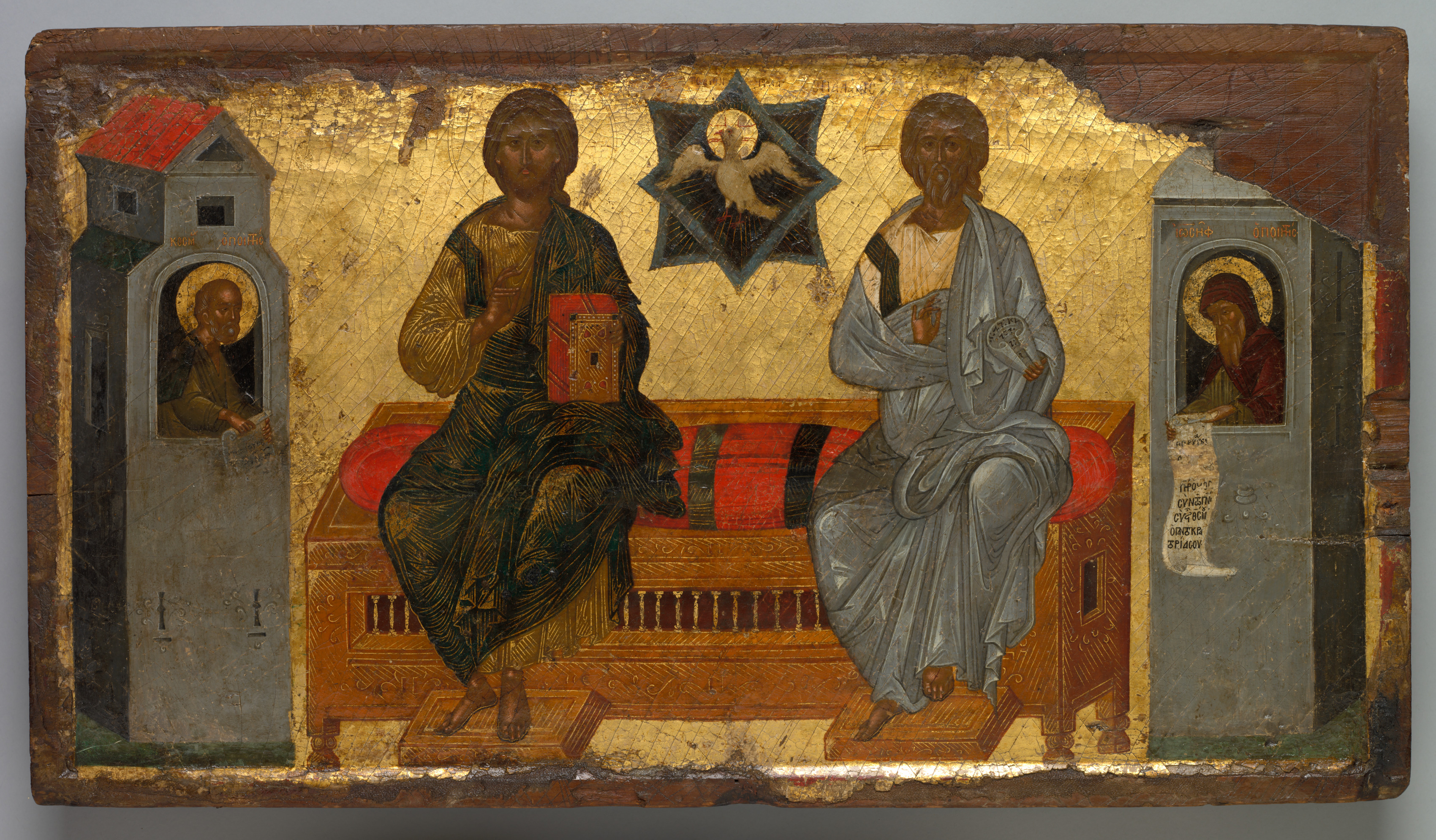
Icon of the New Testament Trinity
Doctrinal reflection
This icon, dateable to c. 1450 and attributed to a Constantinopolitan workshop, represents the so-called 'New Testament Trinity' (Novozavetnaya Troitsa in Slavic usage), a compositional type distinct from the earlier 'Hospitality of Abraham' formula canonized by Andrei Rublev. The panel—tempera and gold on poplar wood—depicts God the Father as the 'Ancient of Days' (cf. Daniel 7:9) enthroned alongside Christ, with the Holy Spirit rendered as a dove descending within an eight-pointed star. The octagram carries specific eschatological freight: the eighth day signifies the age beyond historical time, eternity proper, a concept elaborated in patristic commentary from Basil of Caesarea onward. The flanking hymnographers, including Saint Kosmas the Melodist, ground the image in the doxological tradition of liturgical poetry, embedding the icon within the broader context of Orthodox worship rather than private veneration alone. Theologically, this composition is among the more theologically contested Trinity types; the 1667 Moscow Council would subsequently anathematize it in the Russian context, though its Byzantino-Constantinopolitan antecedents precede that controversy. The icon belongs to the Palaiologan period's final decades, when Constantinopolitan workshops maintained refined technical standards—visible in the gold chrysography and hierarchical spatial arrangement—despite political instability preceding the 1453 Ottoman conquest. The Cleveland Museum of Art panel offers comparative material for studying the transmission of late Byzantine iconographic programs westward and northward. Sources: Belting, H., Likeness and Presence (1994); Maguire, H., The Icons of their Bodies (1996); Ševčenko, N.P., 'Icons in the Liturgy,' Dumbarton Oaks Papers 45 (1991).