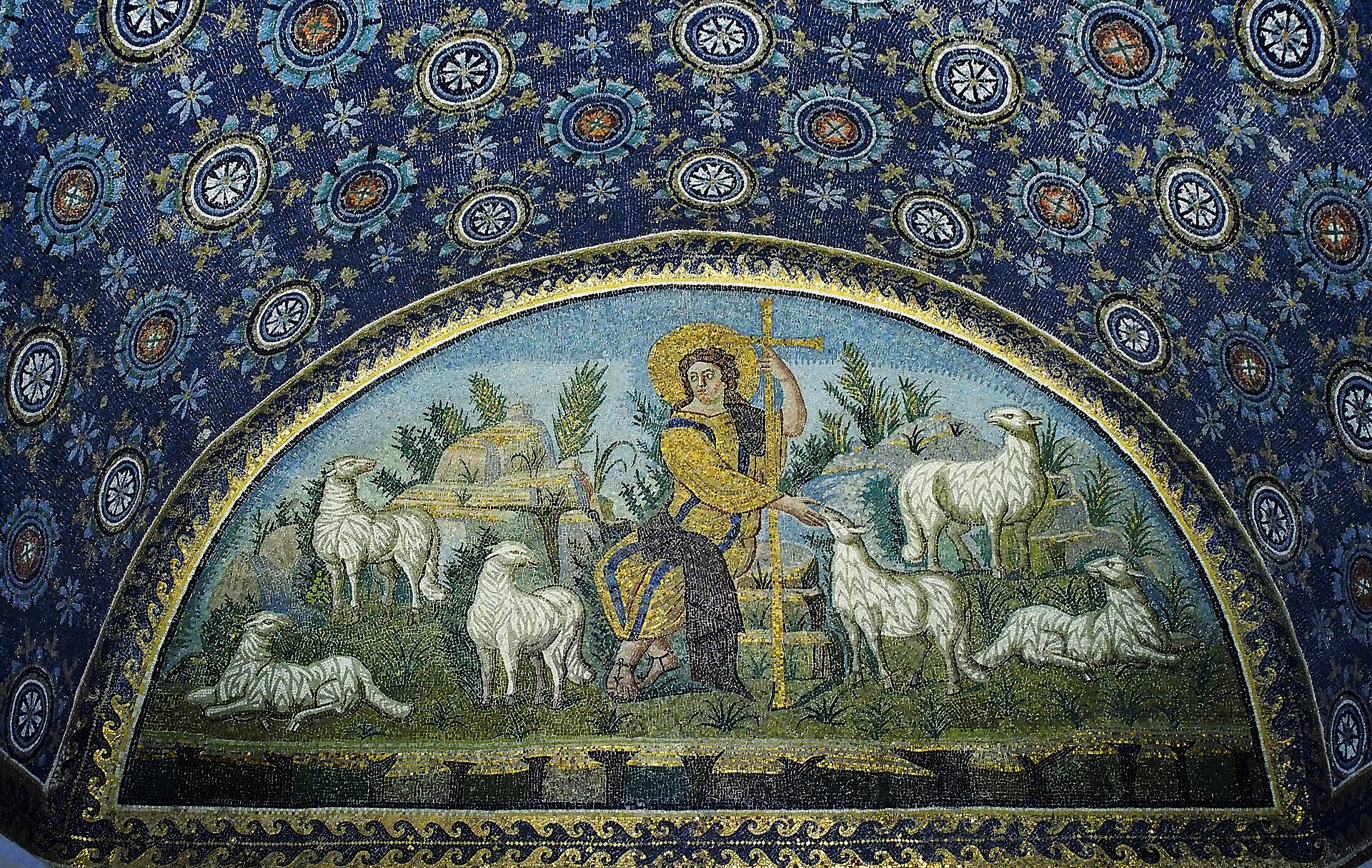
Good Shepherd (Mausoleum of Galla Placidia)
Doctrinal reflection
The Good Shepherd mosaic occupying the lunette of the western entrance wall of the Mausoleum of Galla Placidia, Ravenna, dates to approximately AD 425–450, placing it among the finest survivals of early fifth-century western Christian mosaic production. The mausoleum, traditionally associated with the regent Galla Placidia (died AD 450), is constructed in a cruciform plan and retains a nearly complete decorative program of exceptional chromatic richness. In this lunette, Christ is depicted as a youthful, beardless shepherd seated centrally among six sheep arranged symmetrically across a stylized rocky landscape rendered in warm golden and blue-green tesserae. He wears imperial purple and gold robes rather than the rustic tunic typical of earlier catacomb versions of the motif, signaling a theological and political elevation of the pastoral type: Christ is simultaneously the humble guardian and the sovereign Lord. He holds a long golden cross-staff rather than a shepherd's crook, a detail that introduces eschatological and redemptive valences. The faces of the sheep are individualized with a degree of naturalism unusual for this period, and Christ makes direct ocular contact with the viewer, reinforcing a sense of enacted pastoral care. The gold ground, deployed extensively across this vault program, situates the scene outside historical time and in divine light. Scholars have noted the image's debt to both late antique pastoral conventions and Constantinian court imagery, representing a transitional synthesis characteristic of western workshops in the Theodosian-Valentinianic period. The program as a whole draws on Johannine, Psalmic, and apocalyptic sources in tight theological coordination. Sources: Felix Ravenna; Dumbarton Oaks Papers; Journal of Early Christian Studies.