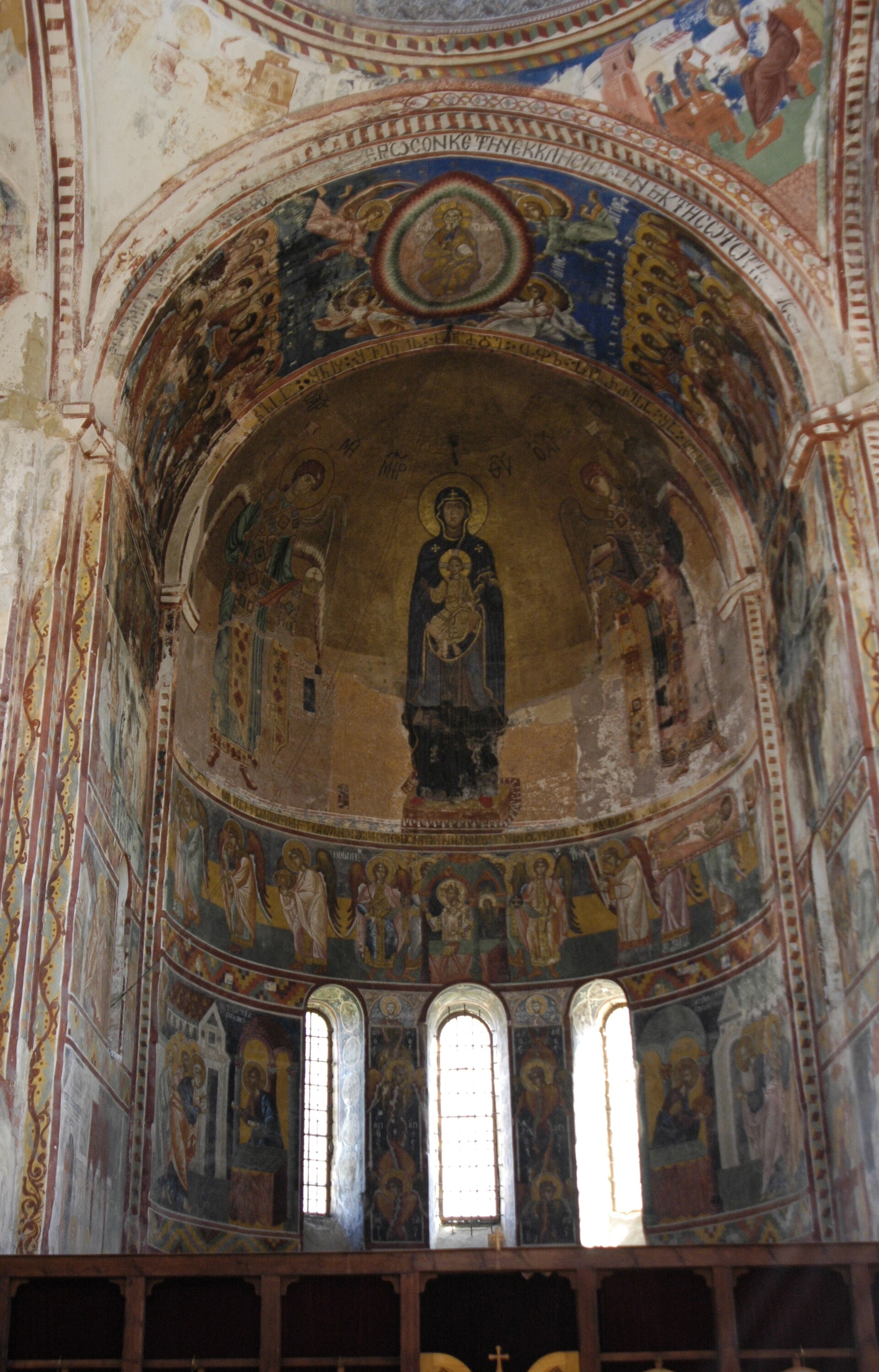
Gelati Theotokos Mosaic
Doctrinal reflection
The Gelati Theotokos mosaic, dated to the early twelfth century AD and situated in the apse of the Cathedral of the Virgin at Gelati Monastery in western Georgia, ranks among the most significant surviving examples of Byzantine-influenced monumental art in the Caucasian sphere. Executed under the patronage of King David IV ('the Builder', r. 1089–1125 AD), the mosaic deploys a standard hieratic program: the enthroned Theotokos in orant-adjacent posture holds the Christ Child Emmanuel on her lap in a mandorla, flanked by the archangels Michael and Gabriel rendered frontally in court dress. The gold tesserae ground situates the figures outside temporal space, conforming to Constantinopolitan apse conventions established by at least the ninth century AD. The Virgin carries the type designation 'Platytera ton Ouranon' ('wider than the heavens') implicit in her monumental scale relative to the flanking figures, underscoring her role as cosmic intercessor and container of the Incarnation. Stylistically, the elongated proportions, refined linear drapery, and restrained chromatic palette reflect close dependence on metropolitan Byzantine workshops, though certain passages of the archangels' facial modeling suggest participation by local Georgian craftsmen. The dedicatory inscription in Georgian reinforces the monument's function within the Bagratid royal program of ecclesiastical patronage, positioning Gelati as a rival to Constantinopolitan prestige centers. The mosaic remains in situ and is designated a UNESCO World Heritage Site. Scholarly significance lies in its evidencing the geographic diffusion of Komnenian mosaic practice beyond imperial frontiers. Sources: Dumbarton Oaks Papers; Revue des études byzantines; Zograf: Journal of Medieval Art.