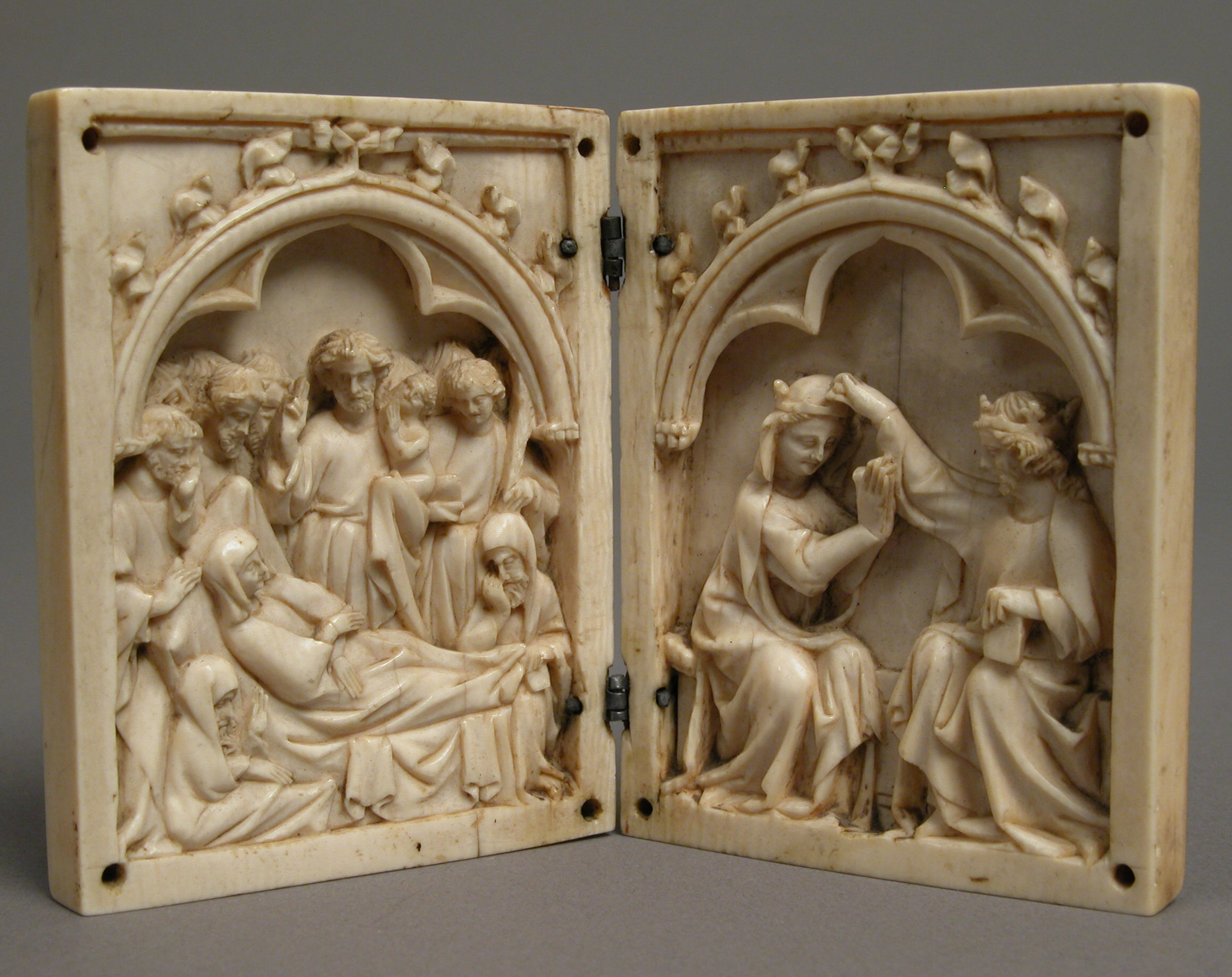
Diptych with the Death and Coronation of the Virgin
Doctrinal reflection
This French ivory diptych, dated ca. 1330–1350 AD and housed in the Medieval Art collection of the Metropolitan Museum of Art (Rogers Fund, 1910), exemplifies the high Gothic courtly devotional tradition in elephant ivory carving. The two-panel format presents sequential Marian narrative: the left wing depicts the Dormition (Death) of the Virgin, while the right depicts her Coronation in heaven. Both scenes belong to a theological program rooted not in Scripture but in post-biblical tradition and conciliar development. The Dormition narrative derives from apocryphal sources, principally the Transitus Mariae literature circulating from late antiquity onward; the Coronation of the Virgin as a formal iconographic type emerges in Western art from the twelfth century AD, elaborated through scholastic Mariology and popularized by devotional literature including the Legenda Aurea. Neither event is recorded in the canonical New Testament. The Coronation motif reflects the medieval doctrinal category of Mary as 'Queen of Heaven,' a title the artwork conveys visually but which is conciliar and medieval in origin, not biblical. Christ, enthroned, places the crown upon Mary's head, rendering her intercessory queenship in visual theology that served private lay devotion. The ivory's fine figural relief, drapery conventions, and facial types are characteristic of the Parisian workshops dominant in northern French Gothic production ca. 1320–1360 AD. Metal mounts indicate the object's liturgical or treasured domestic use. Comparable examples appear across European collections, underscoring the diptych's role as a prestige devotional commodity. Scholarly significance lies in its documentation of high Gothic Marian iconography and ivory-carving workshop practices. Sources: Barnet, Peter, ed., Images in Ivory (Detroit Institute of Arts, 1997); Gaborit-Chopin, Danielle, Ivoires médiévaux (Réunion des musées nationaux, 1978); Williamson, Paul, Gothic Ivory Carving in England (British Museum, 2010).