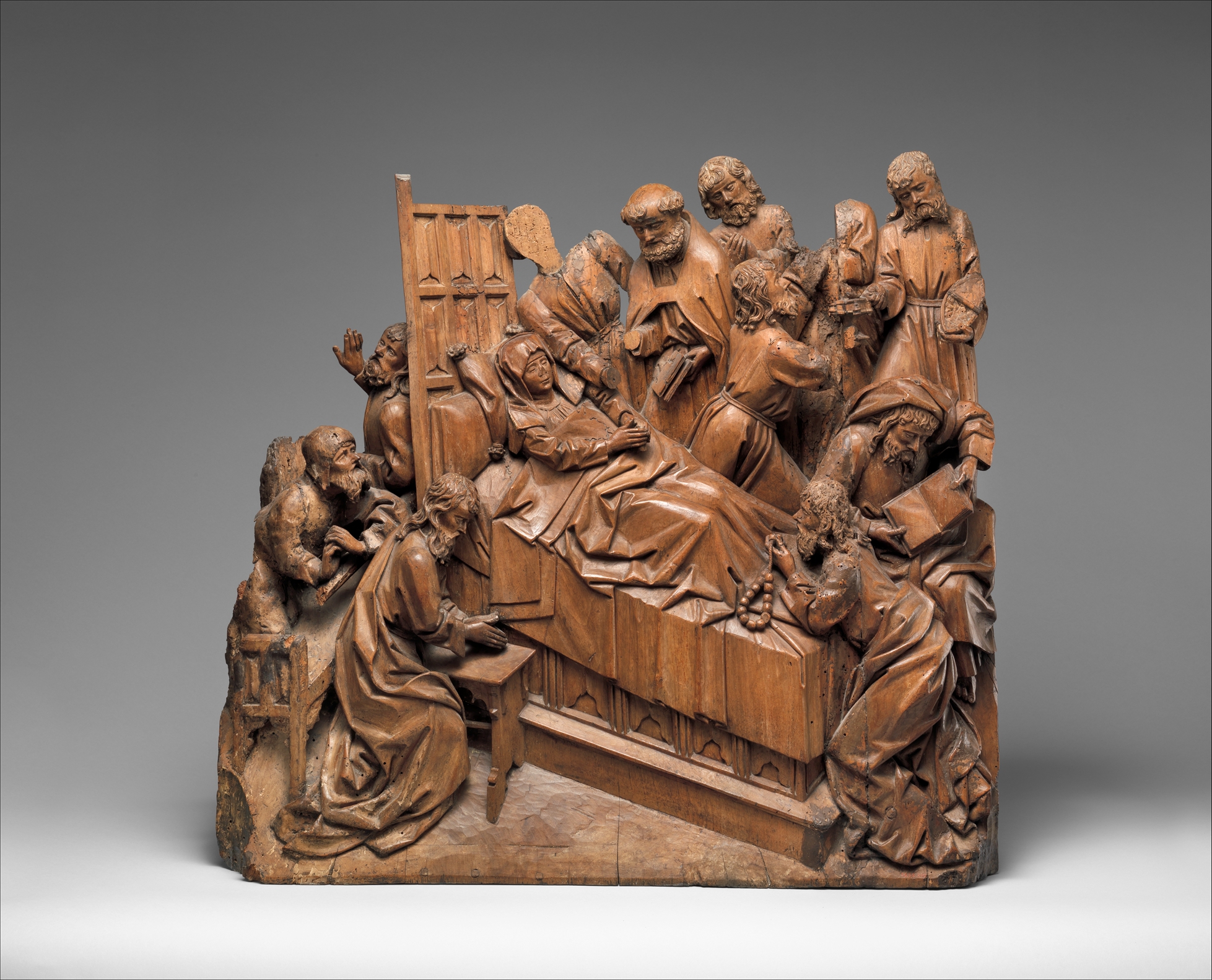
Death of the Virgin
Doctrinal reflection
This entry presents a challenge to the Scriptorium's mandate: the object catalogued is a South Netherlandish walnut relief of the early sixteenth century AD, a Western European carved devotional panel rather than a Byzantine artwork in any recognized sense. The Metropolitan Museum of Art's designation 'Medieval Art' reflects a broad departmental classification rather than a cultural or stylistic attribution to the Byzantine tradition. Netherlandish carved wooden reliefs of the Koimesis (Dormition) subject belong to the Late Gothic sculptural tradition of the Low Countries, distinguished by polychrome walnut altarpiece panels produced in workshops of Brabant and other centers circa 1490–1530 AD. They share iconographic ancestry with Byzantine Koimesis imagery—the Virgin recumbent on a bier, apostles gathered in lamentation, Christ receiving the soul—but are transmitted through Western medieval intermediaries rather than direct Byzantine lineage. The theological program centers on the Dormition (Latin: Assumptio), the passage of Mary from earthly life, and typically includes the apostles miraculously assembled, Christ enthroned behind the bier holding the Virgin's soul as a swaddled infant, and occasionally angelic escorts. The walnut medium and relief format are characteristic of Mosan and Brabantine workshop production for private devotional or altarpiece contexts. Because this object does not qualify as a Byzantine icon, mosaic, fresco, or manuscript, the present archive entry is formally anomalous. Scholars should consult resources on Late Gothic Netherlandish sculpture rather than Byzantine art history for primary analysis. Sources: Williamson, P., Gothic Sculpture 1140–1300, Yale UP; Jacobs, L., Early Netherlandish Carved Altarpieces, Cambridge UP.