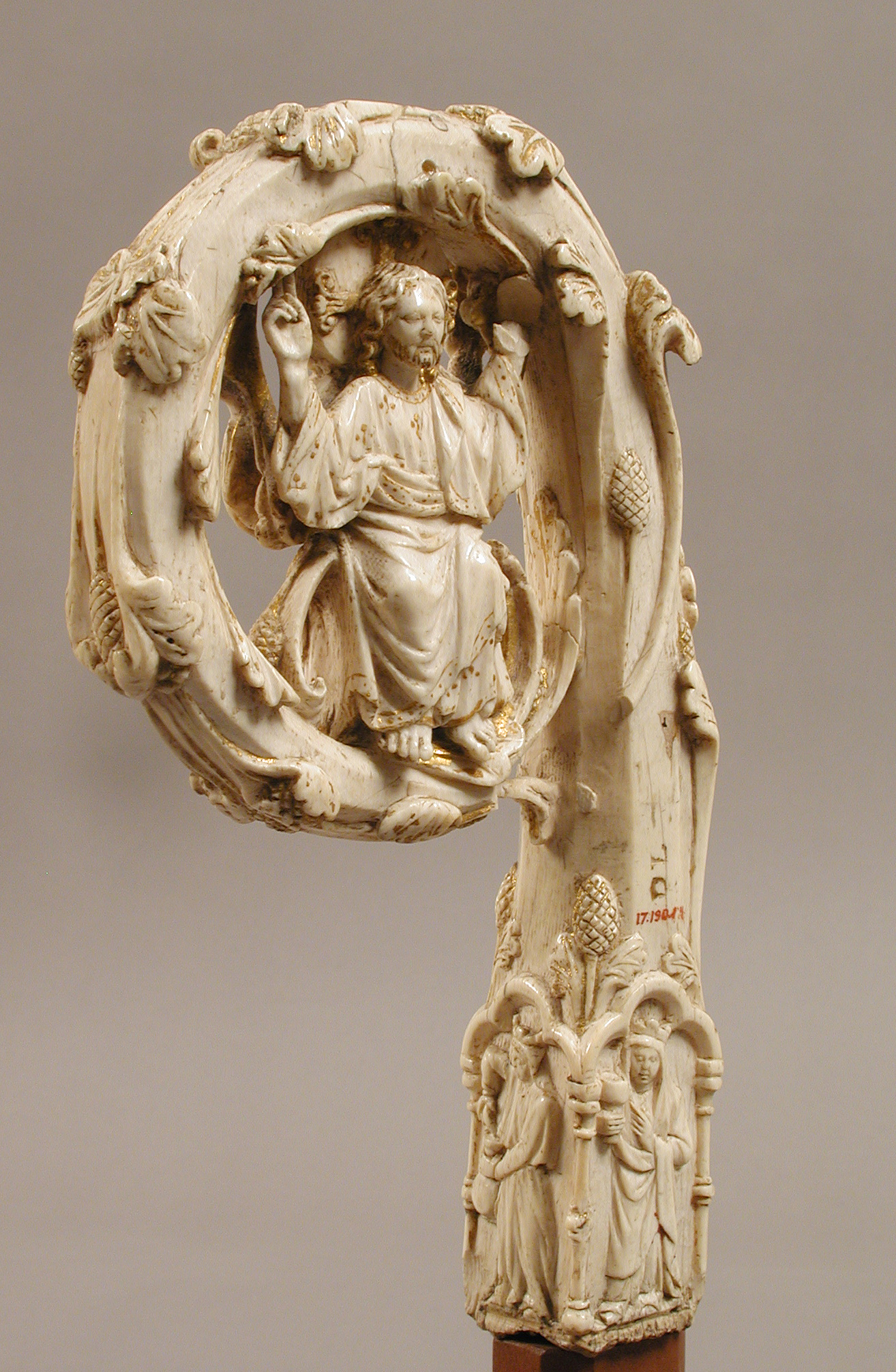
Crozier Head with Double Enthroned Christ
Doctrinal reflection
This crozier head, dated ca. 1350–1375 and attributed to an Italian workshop, is fashioned from elephant ivory with traces of modern paint and gilding, and entered the Metropolitan Museum of Art as part of the Gift of J. Pierpont Morgan in 1917. The object belongs to the category of liturgical episcopal instruments, the pastoral staff (baculum pastorale) serving as the primary emblem of a bishop's jurisdiction and shepherding office. The iconographic program features a doubled or paired enthronement of Christ—a composition that may represent the Maiestas Domini juxtaposed with a Heavenly Court scene, or alternatively a double register presenting two distinct Christological moments within the volute of the crook. Such duality within the confined curvilinear space of a crozier volute is a well-attested solution in Gothic ivory carving, paralleling similar programs in French and north Italian workshops active in the Trecento. The choice of ivory situates this piece within the luxury ecclesiastical arts trade that connected Italian workshops—particularly those of Venice, Milan, and Pisa—to Mediterranean ivory supply networks. Stylistically, the figures reflect Gothic drapery conventions and elongated proportions characteristic of mid-fourteenth-century Italian carving, distinct from but informed by contemporary panel painting traditions. While the object bears traces of modern (re)gilding, its core iconography and formal structure remain legible as a product of Trecento episcopal patronage. This crozier head is significant for tracing the intersection of liturgical function and Christological theology in the material culture of late medieval Italian episcopate. Sources: Barnet, Peter, ed., Images in Ivory: Precious Objects of the Gothic Age (1997); Gaborit-Chopin, Danielle, Ivoires médiévaux (1978); Williamson, Paul, Gothic Ivory Carving in England (2010).