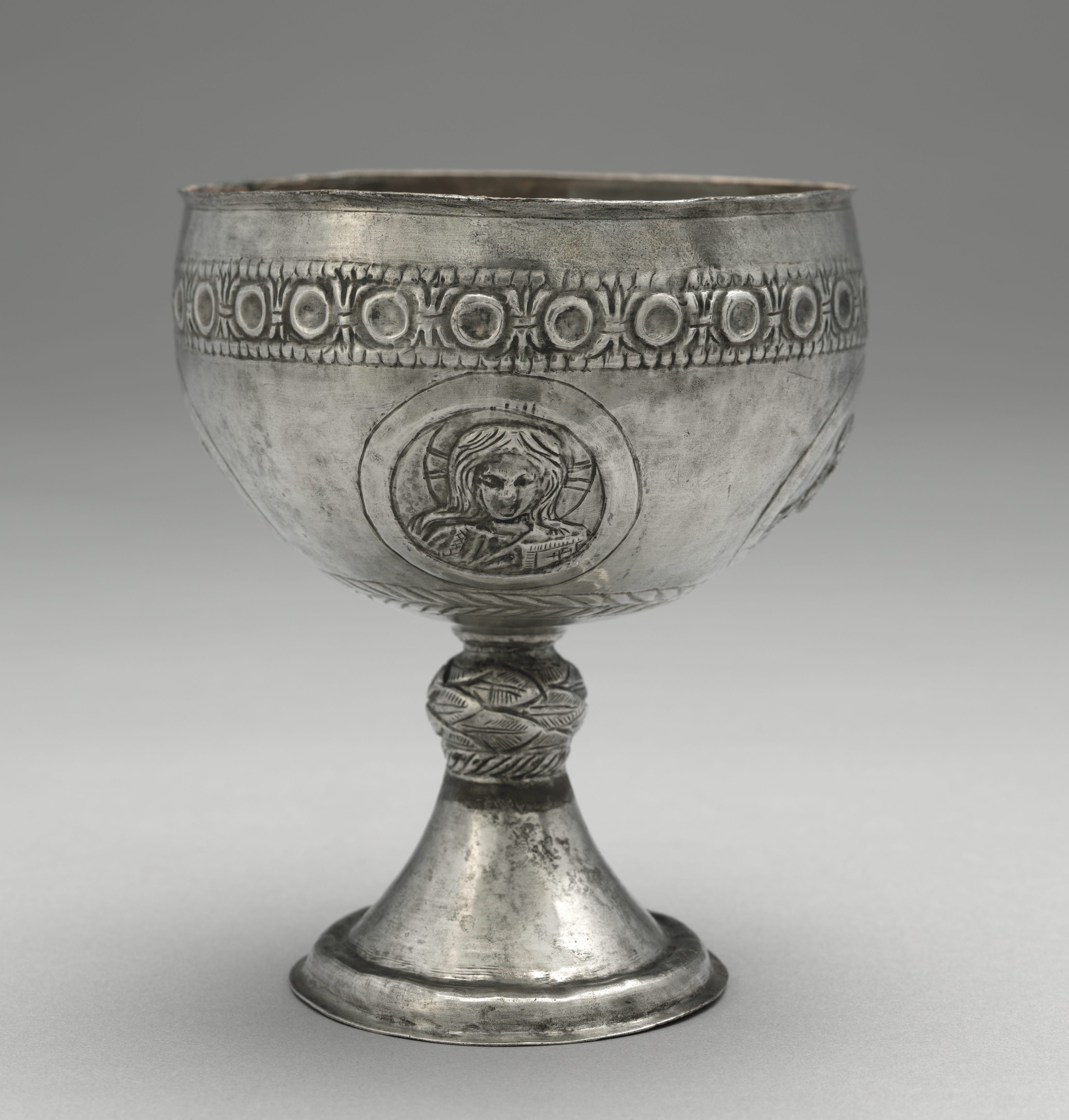
Chalice from the Beth Misona Treasure
Doctrinal reflection
The Beth Misona Treasure, now housed at the Cleveland Museum of Art (accession nos. 1950.378–81), comprises four liturgical silver vessels—one paten and three chalices—associated with the church of Saint Sergios in Beth Misona, a village in northern Syria. Dated broadly to c. 500–700 AD on stylistic and epigraphic grounds, the ensemble belongs to a well-attested corpus of Early Byzantine ecclesiastical silver from the Syrian-Palestinian region, alongside comparable hoards such as the Kaper Koraon and Hama treasures. The paten bears an engraved Latin cross at its center, encircled by a dedicatory inscription naming the donor Domnos and specifying the destination church—a formulaic pattern consistent with sixth- to seventh-century Syrian votive practice. The chalices would have held consecrated wine during the Eucharistic liturgy, functioning as vessels of transformation in the anaphora rite. Their relatively restrained decorative program reflects the theological primacy of the Eucharist itself over ornamental elaboration, though silver as a medium signaled the sanctity and costliness appropriate to sacred use. The treasure's burial is attributed to the Persian or Arab conquests of the 630s–640s AD, a context shared by several other Syrian silver hoards, suggesting systematic concealment of church property under duress. Scholarly analysis has emphasized these objects as evidence for provincial liturgical practice, donor epigraphy, and the material culture of Christianity beyond Constantinople. The cross and inscription typology connect the paten to imperial and ecclesiastical programs of the Justinianic and post-Justinianic periods. Sources: Dumbarton Oaks Papers; Journal of the Walters Art Museum; Mango, Marlia Mundell, 'Silver from Early Byzantium' (1986).