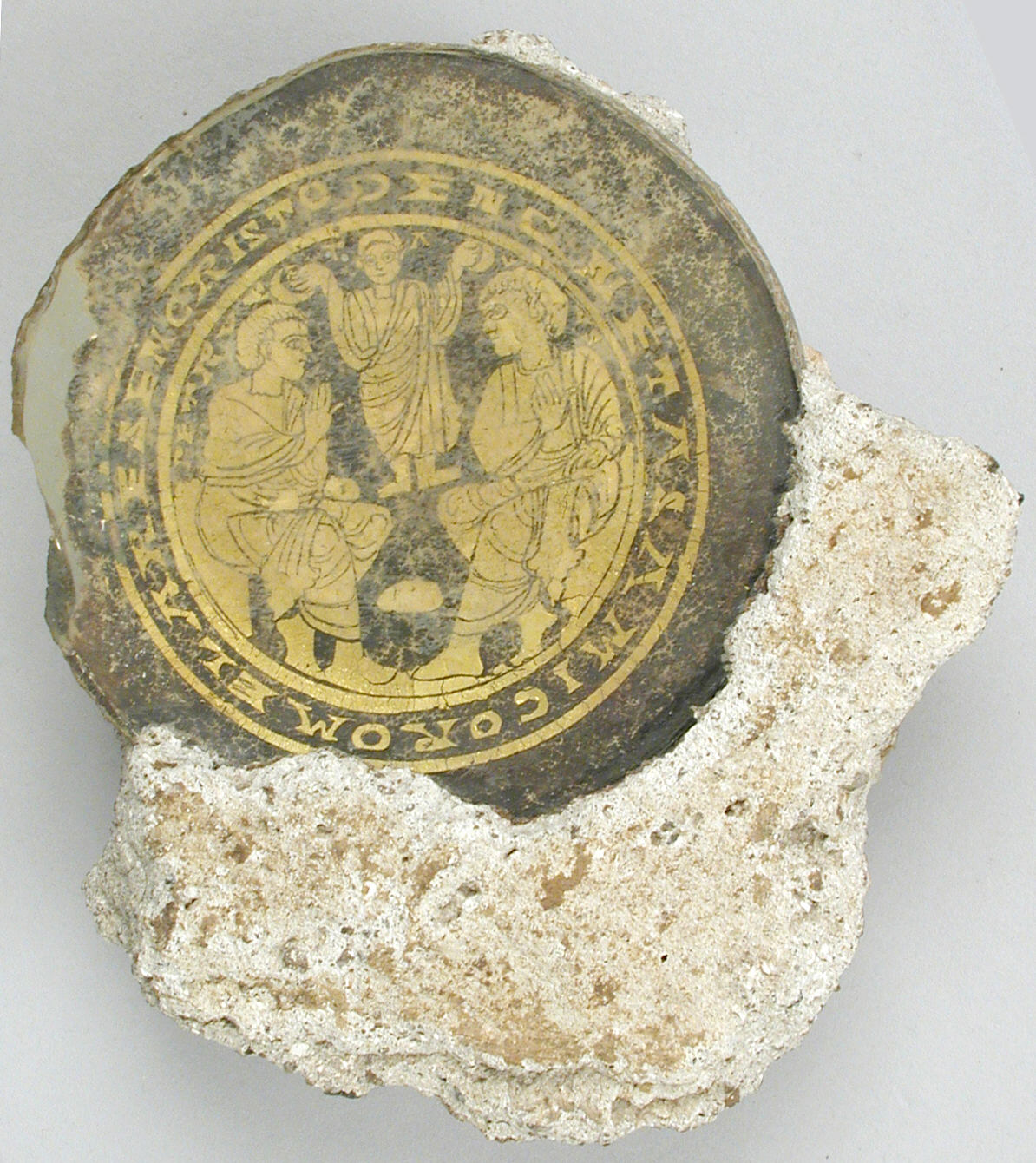
Bowl Base with Christ Giving Martyrs’ Crowns to Saints Peter and Paul
Doctrinal reflection
This bowl base, dated to approximately AD 350 and held in the Medieval Art collection of the Metropolitan Museum of Art (Rogers Fund, 1911), belongs to the corpus of late antique gold-glass (vetro dorato) objects produced in Roman or early Byzantine workshops. The technique involves trapping a layer of gold leaf between two fused layers of glass, with figural designs incised into the gold before sealing. This medium flourished from roughly the third through fifth centuries AD, primarily in Rome, and represents one of the earliest datable Christian decorative art traditions. The iconographic program depicts Christ in a central position distributing martyrs' crowns—stephanos or corona martyrii—to Saints Peter and Paul flanking him. This triadic composition reflects the emergent hierarchical theology of apostolic primacy already crystallizing in the mid-fourth century, the period immediately following the Edict of Milan (AD 313). Peter and Paul together function as the foundationes ecclesiae in contemporary patristic discourse, and their paired veneration in Roman funerary and liturgical contexts is well documented. The crowning gesture evokes Revelation 2:10 ('Be faithful unto death, and I will give you the crown of life') and situates the object within a funerary commemorative function, likely as a grave marker embedded in catacomb mortar. The composition anticipates the hierarchical Christ-flanked-by-apostles schemes that dominate apsidal mosaic programs of the fifth and sixth centuries. Scholarly significance lies in the object's transitional position between late Roman artistic conventions and emergent Byzantine theological iconography. Sources: Journal of Glass Studies; Dumbarton Oaks Papers; Age of Spirituality catalogue (Metropolitan Museum, 1979).