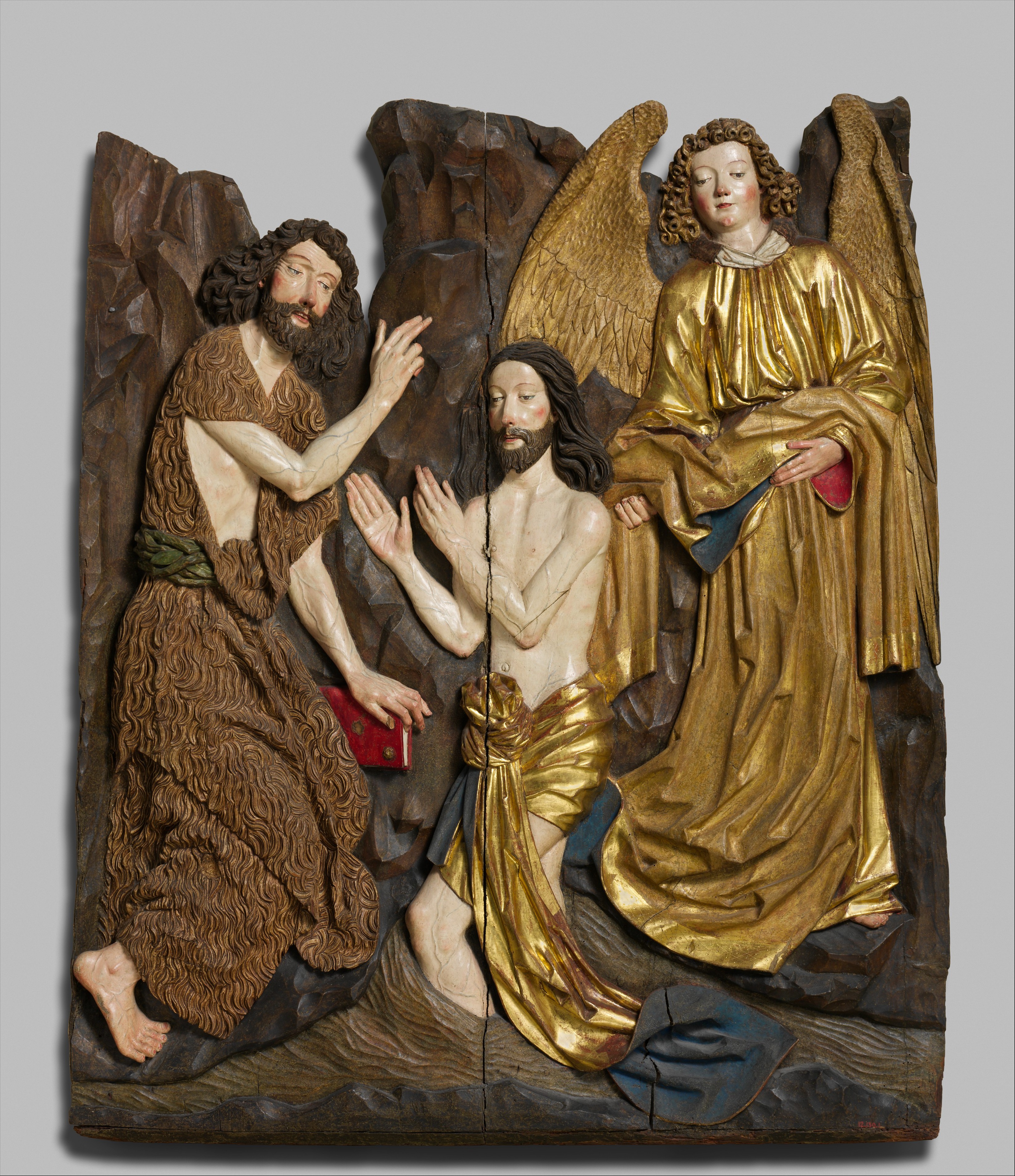
Baptism of Christ
Doctrinal reflection
This entry presents a notable qualification: the object described is a German limewood relief with paint and gilding, dating to approximately AD 1480–1490, held in the Medieval Art collection of the Metropolitan Museum of Art (Rogers Fund, 1912). It is emphatically not a Byzantine artwork—it belongs to the late Gothic sculptural tradition of the Holy Roman Empire, likely produced in a South German or Swabian workshop active in the final decades of the fifteenth century. As such, it falls outside the strict parameters of Byzantine iconographic analysis. That said, the subject—the Baptism of Christ (Greek: Βάπτισις)—carries iconographic conventions that partially descend from Eastern Christian models transmitted westward through manuscript exchange and ivory carving. In Byzantine typology, the Baptism constitutes one of the canonical Twelve Great Feasts (Dodekaorton) and is theologically structured around the Trinitarian epiphany: the Father's voice from heaven, the descent of the Spirit as dove, and the Son standing in the Jordan. Western Gothic renderings of this scene increasingly emphasize narrative naturalism and devotional affect rather than the hieratic frontality characteristic of middle and late Byzantine versions. The limewood medium situates this work firmly within the German tradition of carved altarpiece production. Scholarly assessment of this object properly belongs to Gothic sculpture studies rather than Byzantine art history. An archive entry conforming to Byzantine parameters cannot be responsibly completed for this work without misrepresenting its cultural and technical origins. Sources: Metropolitan Museum of Art collection records; L. Schnitzler, Rheinische Schatzkammer; William D. Wixom, 'Medieval Sculpture at The Cloisters,' Metropolitan Museum of Art Bulletin, 1989.